
Synthetic Opioids, Cartels, and the Transformation of Narco Terrorism into a National Security Threat
April 28, 2026 Dr. Barry Zulauf
At Indic Researchers Forum’s International Conference on Countering Narco Terrorism organised on 10-11 April, 2026, Dr Barry Zulauf, Professor of Applied Intelligence at Georgetown University, a distinguished former Intelligence Community Executive presented a compelling and candid assessment of how synthetic opioids have fundamentally transformed the nature of narco terrorism, elevating it from a law enforcement concern to a central national security challenge.
Opening with a clear disclaimer that the views expressed were personal and not representative of the United States Government or any agency, the speaker provided a rare insider perspective shaped by decades of experience across intelligence and counter narcotics operations.
Until recently, counter narcotics in the United States was largely treated as a law enforcement issue. Agencies such as the Federal Bureau of Investigation, Customs and Border Protection, and the Department of Homeland Security focused primarily on enforcing drug laws, intercepting shipments, and prosecuting traffickers. While there were acknowledged links between narcotics and terrorism, particularly heroin flows from Afghanistan associated with groups such as the Taliban, these connections were limited in scope and strategic impact.
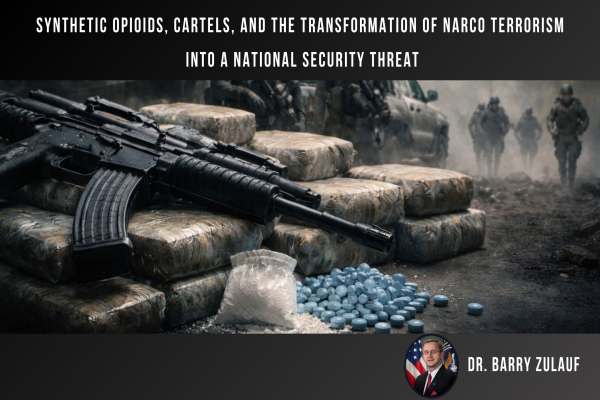
However, the rise of synthetic opioids, particularly fentanyl, has fundamentally altered this landscape. Unlike traditional narcotics, synthetic opioids are significantly more lethal, easier to manufacture, and far more scalable. The speaker emphasized that fentanyl now represents the most deadly category of illicit drugs entering the United States, responsible for tens of thousands of deaths annually. At its peak in the early 2020s, opioid related deaths approached one hundred thousand per year, a figure that underscores the magnitude of the crisis.
What distinguishes this phase is not only the lethality of the substance but the structure of the networks behind it. Mexican drug cartels, long engaged in a violent standoff with state authorities, have evolved into highly sophisticated criminal enterprises. Unlike traditional terrorist organizations, they do not pursue ideological or political objectives, nor do they seek to overthrow the state. Instead, their aim is to weaken governance through corruption, coercion, and violence, ensuring an environment where their operations can continue with minimal interference.
These cartels function less like clandestine cells and more like multinational business conglomerates. Their operations are expansive, involving tens of thousands of members, extensive distribution networks, and deep penetration into major urban centres. Their primary objective is profit, and their violence serves to protect and expand their economic interests.
The threat is further compounded by the integration of multiple illicit activities. The coupling of synthetic opioid trafficking with the smuggling of illegal migrants has created a complex security challenge that extends beyond public health into the realm of border security and national stability. At the same time, the supply chain for precursor chemicals, largely originating from the People’s Republic of China and to some extent other countries, adds a critical international dimension to the problem.
This convergence of factors has led to a significant shift in United States policy. The designation of major cartels and violent criminal gangs such as Tren de Aragua and MS 13 as Foreign Terrorist Organizations reflects a recognition that these entities pose a threat comparable in scale and impact to traditional terrorist groups. This classification enables the use of broader statutory authorities and a more integrated deployment of national power.
A central theme of the address was the necessity of a whole of government approach. The complexity of modern narcotics networks requires close coordination between law enforcement, intelligence, and defense institutions. This marks a departure from earlier approaches that treated these domains in isolation.
The speaker identified several persistent challenges in counter narcotics intelligence. Limited access to timely and actionable information continues to hinder effective operations, despite improvements in interagency cooperation. The decentralized and adaptive nature of trafficking networks makes them difficult to penetrate, as they continuously evolve their methods to evade detection. The use of encryption, counter surveillance, and compartmentalization further complicates intelligence gathering.
Human intelligence remains a critical but challenging component. Understanding how cartels function internally, including their financial mechanisms, supply chains, and decision making processes, requires deep infiltration that carries significant risk. Questions such as how demand for precursor chemicals is communicated, how payments are structured, and how licit supply chains are exploited remain central to dismantling these networks.
International cooperation is equally essential but often constrained by differences in legal frameworks, geopolitical considerations, and operational priorities. As a transnational phenomenon, narcotics trafficking cannot be effectively addressed without sustained collaboration across borders.
The distinction between cartels and traditional terrorist organizations was also carefully examined. While terrorist groups are driven by ideological or political motivations and require limited funding for specific operations, cartels are fundamentally profit driven entities. They require vast and continuous financial flows, often amounting to billions of dollars, and operate with a scale and visibility that differs significantly from covert terrorist cells.
This scale, combined with their widespread presence, makes cartels uniquely dangerous. They are already embedded within societies, possess significant firepower, and have the capacity to exert influence across multiple sectors. Their business oriented structure allows them to adapt rapidly, shifting products, routes, and methods in response to enforcement pressures.
In response to these evolving threats, new strategic priorities have emerged. Efforts are increasingly focused on identifying and targeting critical nodes within cartel networks. These include the supply chains of precursor chemicals, financial intermediaries involved in money laundering, sites of chemical synthesis, and logistical bottlenecks in transportation and storage. By disrupting these nodes, authorities aim to weaken the overall structure of the networks.
Recent policy measures, including executive actions on border security and the designation of cartels as terrorist organizations, have further reinforced this approach. Intelligence and defense institutions are now more actively supporting law enforcement through strategic analysis and targeting information, reflecting a more integrated operational framework.
Looking ahead, the outlook is defined by both urgency and uncertainty. While significant progress has been made in detection, monitoring, and interagency cooperation, the adaptability of these networks ensures that the threat will continue to evolve. The possibility of cartels expanding their violent operational models beyond current theatres, or further integrating with geopolitical actors, remains a concern.
The address concluded with a stark observation that the nature of national security threats is undergoing a fundamental transformation. The most lethal dangers no longer arise solely from states or conventional military forces, but from the intersection of organized crime, synthetic drug production, and transnational illicit networks. The scale of harm caused by synthetic opioids, comparable to repeated mass casualty events, demands a rethinking of how states organize their military, diplomatic, intelligence, and law enforcement capabilities.
Ultimately, the challenge is not simply to combat drug trafficking, but to confront a complex and adaptive system that operates at the intersection of profit, power, and violence. Addressing this threat will require sustained coordination, strategic innovation, and a comprehensive understanding of the evolving nexus between crime and national security.
Opening with a clear disclaimer that the views expressed were personal and not representative of the United States Government or any agency, the speaker provided a rare insider perspective shaped by decades of experience across intelligence and counter narcotics operations.
Until recently, counter narcotics in the United States was largely treated as a law enforcement issue. Agencies such as the Federal Bureau of Investigation, Customs and Border Protection, and the Department of Homeland Security focused primarily on enforcing drug laws, intercepting shipments, and prosecuting traffickers. While there were acknowledged links between narcotics and terrorism, particularly heroin flows from Afghanistan associated with groups such as the Taliban, these connections were limited in scope and strategic impact.
However, the rise of synthetic opioids, particularly fentanyl, has fundamentally altered this landscape. Unlike traditional narcotics, synthetic opioids are significantly more lethal, easier to manufacture, and far more scalable. The speaker emphasized that fentanyl now represents the most deadly category of illicit drugs entering the United States, responsible for tens of thousands of deaths annually. At its peak in the early 2020s, opioid related deaths approached one hundred thousand per year, a figure that underscores the magnitude of the crisis.
What distinguishes this phase is not only the lethality of the substance but the structure of the networks behind it. Mexican drug cartels, long engaged in a violent standoff with state authorities, have evolved into highly sophisticated criminal enterprises. Unlike traditional terrorist organizations, they do not pursue ideological or political objectives, nor do they seek to overthrow the state. Instead, their aim is to weaken governance through corruption, coercion, and violence, ensuring an environment where their operations can continue with minimal interference.
These cartels function less like clandestine cells and more like multinational business conglomerates. Their operations are expansive, involving tens of thousands of members, extensive distribution networks, and deep penetration into major urban centres. Their primary objective is profit, and their violence serves to protect and expand their economic interests.
The threat is further compounded by the integration of multiple illicit activities. The coupling of synthetic opioid trafficking with the smuggling of illegal migrants has created a complex security challenge that extends beyond public health into the realm of border security and national stability. At the same time, the supply chain for precursor chemicals, largely originating from the People’s Republic of China and to some extent other countries, adds a critical international dimension to the problem.
This convergence of factors has led to a significant shift in United States policy. The designation of major cartels and violent criminal gangs such as Tren de Aragua and MS 13 as Foreign Terrorist Organizations reflects a recognition that these entities pose a threat comparable in scale and impact to traditional terrorist groups. This classification enables the use of broader statutory authorities and a more integrated deployment of national power.
A central theme of the address was the necessity of a whole of government approach. The complexity of modern narcotics networks requires close coordination between law enforcement, intelligence, and defense institutions. This marks a departure from earlier approaches that treated these domains in isolation.
The speaker identified several persistent challenges in counter narcotics intelligence. Limited access to timely and actionable information continues to hinder effective operations, despite improvements in interagency cooperation. The decentralized and adaptive nature of trafficking networks makes them difficult to penetrate, as they continuously evolve their methods to evade detection. The use of encryption, counter surveillance, and compartmentalization further complicates intelligence gathering.
Human intelligence remains a critical but challenging component. Understanding how cartels function internally, including their financial mechanisms, supply chains, and decision making processes, requires deep infiltration that carries significant risk. Questions such as how demand for precursor chemicals is communicated, how payments are structured, and how licit supply chains are exploited remain central to dismantling these networks.
International cooperation is equally essential but often constrained by differences in legal frameworks, geopolitical considerations, and operational priorities. As a transnational phenomenon, narcotics trafficking cannot be effectively addressed without sustained collaboration across borders.
The distinction between cartels and traditional terrorist organizations was also carefully examined. While terrorist groups are driven by ideological or political motivations and require limited funding for specific operations, cartels are fundamentally profit driven entities. They require vast and continuous financial flows, often amounting to billions of dollars, and operate with a scale and visibility that differs significantly from covert terrorist cells.
This scale, combined with their widespread presence, makes cartels uniquely dangerous. They are already embedded within societies, possess significant firepower, and have the capacity to exert influence across multiple sectors. Their business oriented structure allows them to adapt rapidly, shifting products, routes, and methods in response to enforcement pressures.
In response to these evolving threats, new strategic priorities have emerged. Efforts are increasingly focused on identifying and targeting critical nodes within cartel networks. These include the supply chains of precursor chemicals, financial intermediaries involved in money laundering, sites of chemical synthesis, and logistical bottlenecks in transportation and storage. By disrupting these nodes, authorities aim to weaken the overall structure of the networks.
Recent policy measures, including executive actions on border security and the designation of cartels as terrorist organizations, have further reinforced this approach. Intelligence and defense institutions are now more actively supporting law enforcement through strategic analysis and targeting information, reflecting a more integrated operational framework.
Looking ahead, the outlook is defined by both urgency and uncertainty. While significant progress has been made in detection, monitoring, and interagency cooperation, the adaptability of these networks ensures that the threat will continue to evolve. The possibility of cartels expanding their violent operational models beyond current theatres, or further integrating with geopolitical actors, remains a concern.
The address concluded with a stark observation that the nature of national security threats is undergoing a fundamental transformation. The most lethal dangers no longer arise solely from states or conventional military forces, but from the intersection of organized crime, synthetic drug production, and transnational illicit networks. The scale of harm caused by synthetic opioids, comparable to repeated mass casualty events, demands a rethinking of how states organize their military, diplomatic, intelligence, and law enforcement capabilities.
Ultimately, the challenge is not simply to combat drug trafficking, but to confront a complex and adaptive system that operates at the intersection of profit, power, and violence. Addressing this threat will require sustained coordination, strategic innovation, and a comprehensive understanding of the evolving nexus between crime and national security.
About the Author:
Dr Barry Zulauf is a Professor of Applied Intelligence at Georgetown University and a distinguished former Intelligence Community Executive.
Note:
The article reflects the opinion of the author and not necessarily the views of the organisation.
Share this article:
© Copyright 2026 Indic Researchers Forum | Designed & Developed By Bigpage.in