
The Australian Illicit Cigarette Trade: The Role of Transnational Organized Crime, Terrorism, and Societal harm
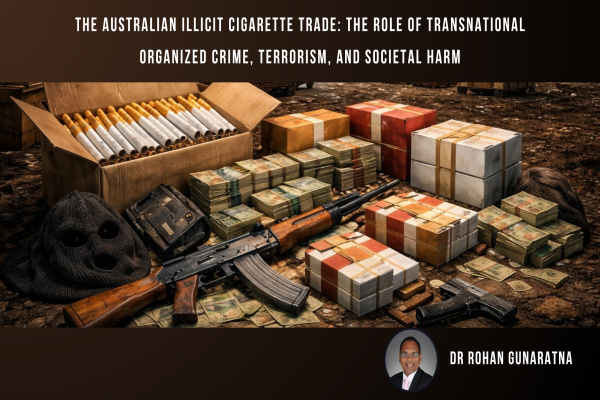
April 02, 2026 Dr Rohan Gunaratna
The Australian Illicit Cigarette Trade is no longer a peripheral concern, it is a central national security challenge. In my assessment, the convergence of organised crime and terrorism within this domain is not hypothetical; it is active, adaptive, and deeply embedded in Australia’s evolving threat landscape.
Today, over half of the tobacco consumed in Australia is sourced from the black market. This is not merely an issue of lost taxation or regulatory evasion, it reflects the gradual erosion of state authority over a critical economic sector. The disappearance of the legal tobacco market is enabling the expansion of transnational criminal enterprises that thrive in regulatory vacuums and exploit systemic vulnerabilities.
More concerning is the clear nexus between these illicit networks and extremist actors. The exploitation of criminal supply chains by Iran’s Islamic Revolutionary Guard Corps, culminating in violent incidents such as the Melbourne synagogue attack and the Sydney café firebombing, illustrates the hybridisation of threats. Criminal networks are no longer operating in isolation; they are being leveraged as instruments of geopolitical and ideological agendas.
This is not without precedent. Following the 2002 Bali bombings, which claimed 88 Australian lives, Australia demonstrated decisive leadership in building a robust counterterrorism architecture. Through close cooperation with regional partners, and with the establishment of institutions such as the Jakarta Centre for Law Enforcement Cooperation, Australia strengthened its offshore capabilities and contributed significantly to ASEAN’s counterterrorism capacity. Engagement with successive leadership, from John Howard to Malcolm Turnbull, alongside dedicated officials such as Dennis Richardson and David Irvine, ensured the disruption of terrorist and criminal infrastructures during a critical period.
However, the threat environment has evolved. The illicit tobacco trade now represents a multidimensional risk. It undermines government revenue, distorts economic stability, and poses significant health and safety challenges to the Australian public. More critically, it provides a permissive ecosystem where organised crime and terrorism intersect, collaborate, and reinforce one another.
This challenge must be recognised as a national priority for three fundamental reasons. First, the illicit tobacco market demonstrates a clear and present crime-terror nexus. Second, it is eroding Australia’s fiscal and economic resilience. Third, it is directly impacting the health and safety of its citizens.
Australia has the institutional strength, experience, and international standing to respond effectively. But this will require a coordinated, far-reaching strategy. A dedicated task force, integrating law enforcement, intelligence agencies, and international partners, is essential to dismantle both the criminal and terrorist infrastructures underpinning this trade. Given the evident Asian and Middle Eastern linkages, Australia must once again lead through regional and global cooperation.
The findings presented in The Australian Illicit Cigarette Trade: The Role of Transnational Organized Crime, Terrorism, and Societal Harm are both a diagnostic and a warning. The crime-terror nexus is now a defining feature of contemporary security threats. Addressing it will demand the same level of urgency, resolve, and strategic foresight that Australia has demonstrated in the past.
Today, over half of the tobacco consumed in Australia is sourced from the black market. This is not merely an issue of lost taxation or regulatory evasion, it reflects the gradual erosion of state authority over a critical economic sector. The disappearance of the legal tobacco market is enabling the expansion of transnational criminal enterprises that thrive in regulatory vacuums and exploit systemic vulnerabilities.
More concerning is the clear nexus between these illicit networks and extremist actors. The exploitation of criminal supply chains by Iran’s Islamic Revolutionary Guard Corps, culminating in violent incidents such as the Melbourne synagogue attack and the Sydney café firebombing, illustrates the hybridisation of threats. Criminal networks are no longer operating in isolation; they are being leveraged as instruments of geopolitical and ideological agendas.
This is not without precedent. Following the 2002 Bali bombings, which claimed 88 Australian lives, Australia demonstrated decisive leadership in building a robust counterterrorism architecture. Through close cooperation with regional partners, and with the establishment of institutions such as the Jakarta Centre for Law Enforcement Cooperation, Australia strengthened its offshore capabilities and contributed significantly to ASEAN’s counterterrorism capacity. Engagement with successive leadership, from John Howard to Malcolm Turnbull, alongside dedicated officials such as Dennis Richardson and David Irvine, ensured the disruption of terrorist and criminal infrastructures during a critical period.
However, the threat environment has evolved. The illicit tobacco trade now represents a multidimensional risk. It undermines government revenue, distorts economic stability, and poses significant health and safety challenges to the Australian public. More critically, it provides a permissive ecosystem where organised crime and terrorism intersect, collaborate, and reinforce one another.
This challenge must be recognised as a national priority for three fundamental reasons. First, the illicit tobacco market demonstrates a clear and present crime-terror nexus. Second, it is eroding Australia’s fiscal and economic resilience. Third, it is directly impacting the health and safety of its citizens.
Australia has the institutional strength, experience, and international standing to respond effectively. But this will require a coordinated, far-reaching strategy. A dedicated task force, integrating law enforcement, intelligence agencies, and international partners, is essential to dismantle both the criminal and terrorist infrastructures underpinning this trade. Given the evident Asian and Middle Eastern linkages, Australia must once again lead through regional and global cooperation.
The findings presented in The Australian Illicit Cigarette Trade: The Role of Transnational Organized Crime, Terrorism, and Societal Harm are both a diagnostic and a warning. The crime-terror nexus is now a defining feature of contemporary security threats. Addressing it will demand the same level of urgency, resolve, and strategic foresight that Australia has demonstrated in the past.
About the Author:
Dr Rohan Gunaratna, Professor of Security Studies at the S. Rajaratnam School of International Studies, Nanyang Technology University, Singapore; leading counter-terrorism expert, author of 16 books, and advisor to governments, with global field experience and testimony before the 9/11 Commission on al Qaeda.
Note:
The article reflects the opinion of the author and not necessarily the views of the organisation.
Share this article:
© Copyright 2026 Indic Researchers Forum | Designed & Developed By Bigpage.in