
India's Great Nicobar Gamble: Why a Remote Island Could Reshape Asian Power Politics
May 22, 2026 Brigadier Sanjay Iyer (Retd.)
The Andaman & Nicobar Islands — A Strategic Gift India Never Fully Unwrapped
If you look at a map of the Indo-Pacific, the Andaman and Nicobar Islands jump out immediately. This chain of over 500 islands stretches roughly 800 kilometres through the eastern Indian Ocean, sitting like a natural barrier across the northern entrance to the Strait of Malacca. It's the kind of geography that military planners dream about. And for most of India's post-independence history, the country largely sat on it and did very little.
That's not entirely India's fault. The islands were always treated more as a distant administrative headache than a strategic asset — underdeveloped, under-resourced, and perpetually low on the priority list in New Delhi. The Andaman and Nicobar Command, established in 2001 as India's only tri-service theatre command, was supposed to change that. And to be fair, it was a step in the right direction. But the Command has punched well below its weight for over two decades, hampered by inadequate infrastructure, limited funding, poor inter-service coordination, and a chronic shortage of the kind of assets — long-range maritime patrol aircraft, submarines, surface combatants — that would make it genuinely formidable.
The facilities that do exist on the islands, primarily at Port Blair on South Andaman, are simply not built for sustained, high-tempo operations. The runway at INS Utkrosh can handle fighters and maritime patrol aircraft, but there's limited capacity for large-scale simultaneous deployments. The harbour infrastructure is similarly modest. What India has right now is an outpost — useful for peacetime surveillance and the occasional exercise, but nowhere near capable of projecting serious power or sustaining operations during a crisis. For an island chain that sits astride one of the world's most important sea lanes, that gap between potential and reality has always been a quiet embarrassment.
Enter Great Nicobar — And a $10 Billion Bet on the Future
Great Nicobar Island is the southernmost point of the Andaman and Nicobar chain, and it sits in a very different strategic neighbourhood than Port Blair. It's barely 150 kilometres from the northern tip of Sumatra and directly overlooks the Malacca Strait's western entrance. Whatever happens in that strait — commercially, militarily, diplomatically — you have a front-row seat from Great Nicobar.
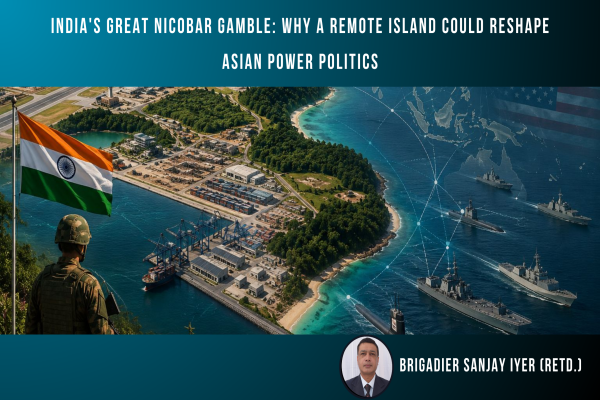
India's plan for the island is ambitious by any measure. The project involves a transshipment port capable of handling large container vessels, a greenfield international airport, a township to house the civilian and military population, and — crucially — expanded military infrastructure that will allow for sustained naval and air deployments. The total investment is pegged at around $10 billion, spread over decades, with the project categorised as a national security priority.
The commercial logic and the strategic logic here reinforce each other neatly. A functioning deep-water transshipment port at Great Nicobar would allow India to capture cargo that currently gets routed through Singapore and Colombo — a genuine economic opportunity. But it also means that the infrastructure India builds for commercial purposes doubles as cover and support for military assets. The port facilities can berth warships. The airbase supports both civilian flights and fighter or maritime patrol aircraft. The logistics network sustains not just cargo operations but forward military deployments. It's a dual-use project in the most literal sense, and that's exactly what makes it so valuable.
The island's development directly addresses the core weakness of India's current Andaman and Nicobar posture — the absence of a credible, sustained presence at the southern end of the chain, closest to the chokepoint that matters most. Port Blair is useful but geographically removed from the action. Great Nicobar puts India right at the door.
Why This Matters for India's Security — More Than Just Watching China
It's tempting to frame the Great Nicobar project purely as an anti-China move, and while that dimension is real, it's worth stepping back and looking at the broader picture first.
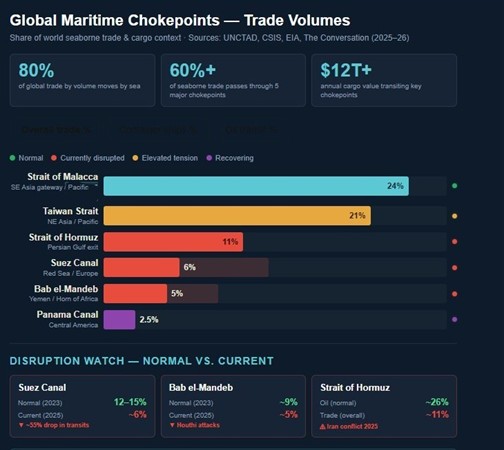
It's worth clearing up a common misconception here. India's oil does not flow through the Malacca Strait — that's primarily China's problem, not India's. India sources roughly half its crude from the Middle East, which arrives directly across the Arabian Sea through the Strait of Hormuz to its western ports. Most of the rest comes from Russia, crossing the Indian Ocean directly. Malacca simply isn't in the picture for India's energy supply chain.
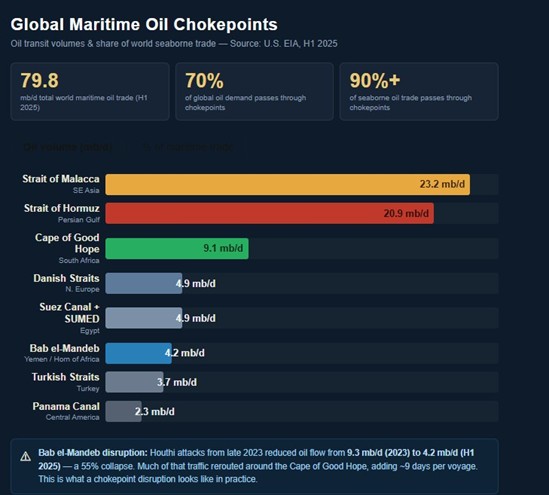
What India does move through the eastern Indian Ocean is general seaborne trade — goods going to and from East and Southeast Asia. And there's a subtler but more important point: the value of Great Nicobar for India isn't about protecting its own energy lifeline. It's about sitting astride someone else's. China moves roughly 80% of its oil imports through Malacca. Japan and South Korea are similarly dependent. India's presence at the southern tip of the Andaman chain gives it a front-row seat — and potential leverage — over the energy jugular of its primary strategic competitor. That's not a defensive posture. That's a strategic asset of a different order entirely.
There's also the question of real-time awareness. Right now, India's picture of what's happening in the eastern Indian Ocean — which vessels are moving where, what military assets are transiting the area — is patchier than it should be for a country of India's ambitions. Persistent surveillance assets based out of Great Nicobar would dramatically improve that picture. You can't manage a sea lane you can't see clearly, and India's current visibility has gaps.
Then there's the question of deterrence. A credible military presence at a strategically vital location changes how adversaries calculate risk. It doesn't need to be deployed aggressively — just existing, with the capability to act, shifts the regional balance in ways that matter during crises and negotiations alike. Great Nicobar gives India something it currently lacks: a forward operating hub in the eastern Indian Ocean that's capable of sustaining real military power, not just making a symbolic visit.
Now For the Part Beijing Really Doesn't Like
China has worried about the Malacca Strait for a long time. President Hu Jintao articulated what became known as the "Malacca dilemma" back in 2003 — the strategic vulnerability of having the bulk of China's energy imports and seaborne trade moving through a narrow passage that China doesn't control and can't easily defend. That anxiety has driven enormous Chinese investment in alternative routes, port access agreements across the Indian Ocean, and the accelerated development of the PLA Navy. But the dilemma itself hasn't gone away, because geography doesn't change.
The numbers are stark. Somewhere around 70–80% of China's oil imports move through the South China Sea–Malacca corridor. A large share of its LNG and general trade follows the same path. The Strait of Malacca moves roughly 16 million barrels of petroleum per day — second only to Hormuz as an oil chokepoint globally. For China, any serious disruption to this corridor doesn't just hurt — it creates an economic crisis within weeks.
Great Nicobar sits squarely in the middle of this anxiety. India developing serious naval and air capabilities there means China has to account for Indian surveillance and potential interdiction of PLA Navy vessels transiting between the western Pacific and the Indian Ocean. In a crisis — say, over Taiwan, or a confrontation in the South China Sea — China would have to plan for the possibility that India could complicate or monitor the movement of its naval assets through this corridor. That's not a comfortable position to be in when you're already managing multiple strategic fronts.
The alternatives China has are real but painful. The Sunda Strait between Java and Sumatra or the Lombok Strait further east are both navigable alternatives to Malacca, but they add significant distance and transit time to voyages between China's eastern coast and the Indian Ocean. For commercial vessels operating on tight margins, that cost adds up fast. For naval vessels trying to move quickly during a crisis, those extra days matter enormously.
Will China react? Almost certainly, though probably not in the dramatic, confrontational way that headlines might suggest. Beijing is more likely to accelerate its existing hedging strategies — deepening port access agreements with countries like Myanmar, Pakistan and Sri Lanka, expanding the PLA Navy's Indian Ocean presence, and pushing harder on overland pipeline and infrastructure routes that bypass the maritime chokepoint entirely. China may also apply diplomatic pressure on India through bilateral channels and use its leverage with countries like Bangladesh or Nepal to signal displeasure. What it's unlikely to do is take any direct action against the project itself — that would cross lines that even Beijing's current leadership would be cautious about.
The more interesting question is how this feeds into the broader India-China strategic competition over the next decade. Great Nicobar is one piece of a larger puzzle — alongside India's growing Quad commitments, its expanding maritime partnership with the US, Japan and Australia, and its own accelerating naval modernisation programme. Each of these moves nudges the regional balance a little further away from Chinese dominance of the Indo-Pacific commons. Great Nicobar doesn't change everything on its own. But it fills a gap that has long been a quiet vulnerability in India's strategic posture — and that's precisely why, when you look at the map and understand what's at stake in that narrow stretch of water, the $10 billion starts to look less like a gamble and more like overdue homework.
If you look at a map of the Indo-Pacific, the Andaman and Nicobar Islands jump out immediately. This chain of over 500 islands stretches roughly 800 kilometres through the eastern Indian Ocean, sitting like a natural barrier across the northern entrance to the Strait of Malacca. It's the kind of geography that military planners dream about. And for most of India's post-independence history, the country largely sat on it and did very little.
That's not entirely India's fault. The islands were always treated more as a distant administrative headache than a strategic asset — underdeveloped, under-resourced, and perpetually low on the priority list in New Delhi. The Andaman and Nicobar Command, established in 2001 as India's only tri-service theatre command, was supposed to change that. And to be fair, it was a step in the right direction. But the Command has punched well below its weight for over two decades, hampered by inadequate infrastructure, limited funding, poor inter-service coordination, and a chronic shortage of the kind of assets — long-range maritime patrol aircraft, submarines, surface combatants — that would make it genuinely formidable.
The facilities that do exist on the islands, primarily at Port Blair on South Andaman, are simply not built for sustained, high-tempo operations. The runway at INS Utkrosh can handle fighters and maritime patrol aircraft, but there's limited capacity for large-scale simultaneous deployments. The harbour infrastructure is similarly modest. What India has right now is an outpost — useful for peacetime surveillance and the occasional exercise, but nowhere near capable of projecting serious power or sustaining operations during a crisis. For an island chain that sits astride one of the world's most important sea lanes, that gap between potential and reality has always been a quiet embarrassment.
Enter Great Nicobar — And a $10 Billion Bet on the Future
Great Nicobar Island is the southernmost point of the Andaman and Nicobar chain, and it sits in a very different strategic neighbourhood than Port Blair. It's barely 150 kilometres from the northern tip of Sumatra and directly overlooks the Malacca Strait's western entrance. Whatever happens in that strait — commercially, militarily, diplomatically — you have a front-row seat from Great Nicobar.
India's plan for the island is ambitious by any measure. The project involves a transshipment port capable of handling large container vessels, a greenfield international airport, a township to house the civilian and military population, and — crucially — expanded military infrastructure that will allow for sustained naval and air deployments. The total investment is pegged at around $10 billion, spread over decades, with the project categorised as a national security priority.
The commercial logic and the strategic logic here reinforce each other neatly. A functioning deep-water transshipment port at Great Nicobar would allow India to capture cargo that currently gets routed through Singapore and Colombo — a genuine economic opportunity. But it also means that the infrastructure India builds for commercial purposes doubles as cover and support for military assets. The port facilities can berth warships. The airbase supports both civilian flights and fighter or maritime patrol aircraft. The logistics network sustains not just cargo operations but forward military deployments. It's a dual-use project in the most literal sense, and that's exactly what makes it so valuable.
The island's development directly addresses the core weakness of India's current Andaman and Nicobar posture — the absence of a credible, sustained presence at the southern end of the chain, closest to the chokepoint that matters most. Port Blair is useful but geographically removed from the action. Great Nicobar puts India right at the door.
Why This Matters for India's Security — More Than Just Watching China
It's tempting to frame the Great Nicobar project purely as an anti-China move, and while that dimension is real, it's worth stepping back and looking at the broader picture first.
It's worth clearing up a common misconception here. India's oil does not flow through the Malacca Strait — that's primarily China's problem, not India's. India sources roughly half its crude from the Middle East, which arrives directly across the Arabian Sea through the Strait of Hormuz to its western ports. Most of the rest comes from Russia, crossing the Indian Ocean directly. Malacca simply isn't in the picture for India's energy supply chain.
What India does move through the eastern Indian Ocean is general seaborne trade — goods going to and from East and Southeast Asia. And there's a subtler but more important point: the value of Great Nicobar for India isn't about protecting its own energy lifeline. It's about sitting astride someone else's. China moves roughly 80% of its oil imports through Malacca. Japan and South Korea are similarly dependent. India's presence at the southern tip of the Andaman chain gives it a front-row seat — and potential leverage — over the energy jugular of its primary strategic competitor. That's not a defensive posture. That's a strategic asset of a different order entirely.
There's also the question of real-time awareness. Right now, India's picture of what's happening in the eastern Indian Ocean — which vessels are moving where, what military assets are transiting the area — is patchier than it should be for a country of India's ambitions. Persistent surveillance assets based out of Great Nicobar would dramatically improve that picture. You can't manage a sea lane you can't see clearly, and India's current visibility has gaps.
Then there's the question of deterrence. A credible military presence at a strategically vital location changes how adversaries calculate risk. It doesn't need to be deployed aggressively — just existing, with the capability to act, shifts the regional balance in ways that matter during crises and negotiations alike. Great Nicobar gives India something it currently lacks: a forward operating hub in the eastern Indian Ocean that's capable of sustaining real military power, not just making a symbolic visit.
Now For the Part Beijing Really Doesn't Like
China has worried about the Malacca Strait for a long time. President Hu Jintao articulated what became known as the "Malacca dilemma" back in 2003 — the strategic vulnerability of having the bulk of China's energy imports and seaborne trade moving through a narrow passage that China doesn't control and can't easily defend. That anxiety has driven enormous Chinese investment in alternative routes, port access agreements across the Indian Ocean, and the accelerated development of the PLA Navy. But the dilemma itself hasn't gone away, because geography doesn't change.
The numbers are stark. Somewhere around 70–80% of China's oil imports move through the South China Sea–Malacca corridor. A large share of its LNG and general trade follows the same path. The Strait of Malacca moves roughly 16 million barrels of petroleum per day — second only to Hormuz as an oil chokepoint globally. For China, any serious disruption to this corridor doesn't just hurt — it creates an economic crisis within weeks.
Great Nicobar sits squarely in the middle of this anxiety. India developing serious naval and air capabilities there means China has to account for Indian surveillance and potential interdiction of PLA Navy vessels transiting between the western Pacific and the Indian Ocean. In a crisis — say, over Taiwan, or a confrontation in the South China Sea — China would have to plan for the possibility that India could complicate or monitor the movement of its naval assets through this corridor. That's not a comfortable position to be in when you're already managing multiple strategic fronts.
The alternatives China has are real but painful. The Sunda Strait between Java and Sumatra or the Lombok Strait further east are both navigable alternatives to Malacca, but they add significant distance and transit time to voyages between China's eastern coast and the Indian Ocean. For commercial vessels operating on tight margins, that cost adds up fast. For naval vessels trying to move quickly during a crisis, those extra days matter enormously.
Will China react? Almost certainly, though probably not in the dramatic, confrontational way that headlines might suggest. Beijing is more likely to accelerate its existing hedging strategies — deepening port access agreements with countries like Myanmar, Pakistan and Sri Lanka, expanding the PLA Navy's Indian Ocean presence, and pushing harder on overland pipeline and infrastructure routes that bypass the maritime chokepoint entirely. China may also apply diplomatic pressure on India through bilateral channels and use its leverage with countries like Bangladesh or Nepal to signal displeasure. What it's unlikely to do is take any direct action against the project itself — that would cross lines that even Beijing's current leadership would be cautious about.
The more interesting question is how this feeds into the broader India-China strategic competition over the next decade. Great Nicobar is one piece of a larger puzzle — alongside India's growing Quad commitments, its expanding maritime partnership with the US, Japan and Australia, and its own accelerating naval modernisation programme. Each of these moves nudges the regional balance a little further away from Chinese dominance of the Indo-Pacific commons. Great Nicobar doesn't change everything on its own. But it fills a gap that has long been a quiet vulnerability in India's strategic posture — and that's precisely why, when you look at the map and understand what's at stake in that narrow stretch of water, the $10 billion starts to look less like a gamble and more like overdue homework.
About the Author:
Brigadier Sanjay Iyer (Retd.) is the Former Defence Attaché to Germany, Austria and Switzerland, Government of India
Note:
The article reflects the opinion of the author and not necessarily the views of the organisation.
Share this article:
© Copyright 2026 Indic Researchers Forum | Designed & Developed By Bigpage.in