
Quantum Frontiers – Geopolitical Implications of the Quantum Technology Race
February 01, 2026 Rajas Purandare
Abstract –
Quantum technology is founded on the principles of quantum mechanics, the laws of physics governing subatomic particles. One of the primary applications of quantum technology today is quantum computing, which processes data in fundamentally different ways compared to conventional computers. Quantum physics is the “study of matter and energy at the most fundamental level.” Quantum technologies leverage the unique properties described by quantum physics to introduce new capabilities in computing, communications and sensing.
As quantum computing, communication and sensing capabilities mature, they promise to revolutionise national security architecture, disrupt cybersecurity paradigms and reshape global power hierarchies. The article examines the strategic implications of quantum technology innovations within the context of escalating geopolitical rivalries, with a particular focus on its military applications in the Indo-Pacific region, a key arena for geopolitical competition. It focuses on China’s aggressive pursuit of quantum-enabled defence capabilities and its broader ambition to assert technological and military dominance.
Keywords – Quantum computing, cybersecurity, geopolitics, national security
Research Questions –
Review of Literature –
Khyati Singh, in her article entitled “Quantum Computing in Asia” (2024), presents a comprehensive assessment of the state of quantum computing across several Asian nations, focusing on technological development, national strategies, and geopolitical implications. The study identifies the region's leading actors - namely China, Japan, South Korea, and India- and evaluates their respective investments, institutional frameworks and international collaborations.
It suggests that the race for quantum supremacy could destabilise traditional deterrence models, especially in cyber and space domains. This aligns with existing theoretical frameworks in security studies that warn about quantum disruptions in intelligence, encryption and surveillance.
Elsa B. Kania in her paper entitled “China’s Strategic Ambiguity and Quantum Technology” (2018) provides a detailed analysis of China’s strategic approach to emerging technologies particularly quantum technology, within the broader context of great power competition with the U.S. Drawing from historical, political and strategic perspectives, the article frames China’s technological ambitions as a response to historical vulnerabilities and as a core element of its national rejuvenation campaign.The literature reflects a growing consensus that China’s techno-nationalism, driven by policies of Indigenous innovation, strategic military-civil fusion and tightly integrated party-state control, has placed it on a trajectory to challenge U.S. leadership in disruptive technologies, including quantum computing and quantum communications. Kania also situates China’s quantum strategy within broader statecraft, highlighting its integration with initiatives like the Digital Silk Road and its efforts to shape global standards and norms.
Frank Arute et al. in their article titled “Quantum Supremacy Using a Programmable Superconducting Processor” (2019) focus on the experimental demonstration of quantum supremacy—the milestone at which a quantum computer can perform a task that is infeasible for any classical supercomputer. The authors employed a 53-qubit superconducting processor, known as Sycamore, to execute a random quantum circuit sampling task in approximately 200 seconds, an endeavour they estimate would take 10,000 years on a cutting-edge supercomputer.
This study contributes to the existing literature by not only validating the correctness of the computation through classical simulation, where applicable, but also by introducing cross-entropy benchmarking to estimate fidelity in contexts beyond classical validation.
Shalaev et al. (2025) in their article entitled Photonic Networking of Quantum Memories in High-Dimensions, present an experimental advancement in quantum networking by demonstrating entanglement between high-dimensional quantum memories or qudits using single atoms and time-bin-encoded photons. Unlike conventional quantum networks that rely on two-level systems (qubits), this study uses qudits to expand the information-carrying capacity of quantum networks.
In a geopolitical context, this paper will help provide insights about advances in quantum networking underpinning secure communication networks, which are strategic assets for national security and can shift the balance of power in cyber and military domains.
Huang Jhon Preskill et al. (2022) in their article “Quantum Advantage in Learning from Experiments” explore the concept of quantum advantage in experimental learning tasks, demonstrating that quantum-enhanced approaches can significantly outperform classical methods in extracting information from physical systems.
The study introduces three classes of learning tasks – predicting physical properties, performing the quantum principal component analysis (PCA) and modelling physical dynamics where quantum systems show exponential gains in efficiency. Using 40 superconducting qubits on Google’s sycamore quantum processor, the authors conduct proof–of–principal experiments validating these theoretical predictions even under noisy conditions.
The study confirms that quantum systems can perform accurate learning with far fewer experimental repetitions, making them suitable for near-term applications in quantum sensing and machine learning.
Prateek Tripathi, in his article entitled “Quantum Technology: Exploring India-Taiwan Cooperation”, explores the nascent yet strategically significant collaboration between India and Taiwan in the field of quantum computing. The article situates this cooperation within broader geopolitical and technological contexts, especially amidst increasing export controls and a global push for supply chains independent of China.
The article also highlights India’s National Quantum Mission (NQM), which aims to develop indigenous capabilities in quantum computing, sensing, communications and materials. The potential cooperation between the two countries is highlighted by Taiwan’s semiconductor expertise and India’s advances in quantum sensing and communications. Tripathi advocates for structured engagements through academic exchanges, joint R&D programs, and private sector collaborations, building upon- India-Taiwan Science and Technology program.
Research Methodology -
In this research article, qualitative research methods have been used. The research primarily uses secondary data, which includes peer-reviewed journal articles (e.g. Arute et al., 2019; Shalaev et al., 2025), policy papers and strategic reports, expert reports, and think tank publications (e.g. Brookings Institution, CSET, and RAND). The article aims to assess the intersection of quantum technologies with national defence, applying a geopolitical perspective to discuss how emerging quantum technologies influence the balance of power, specifically in the Indo-Pacific theatre.
Introduction –
Quantum technologies represent a broad set of emerging innovations that exploit principles of quantum mechanics to surpass the limitations of classical systems. Key domains in the field include Quantum computing which utilises quantum bits (qubits) and phenomena such as superposition and entanglement to perform complex computations more efficiently; quantum cryptography, which applies quantum principles to enable secure key distribution and encryption; and quantum communication, which leverages quantum states to transmit information, offering the potential for inherently secure communication channels.
Quantum Computing –
Quantum computing is an emerging field at the intersection of computer science and quantum physics, aiming to solve problems currently intractable for classical supercomputers. It encompasses various subfields, including the development of quantum hardware and the design of quantum algorithms. Although still in its early stages, quantum computing holds the potential to outperform classical systems in solving complex computational tasks, particularly those requiring exponential resources or time.
A foundational understanding of quantum computing requires familiarity with four key principles of quantum mechanics – superposition, entanglement, decoherence and interference.
Unlike classical computers, which use binary bits (0s and 1s) to store and process information, quantum computers use qubits, which can exist in a superposition of states. A qubit can represent a 0 or 1, or any weighted combination of both simultaneously. This property allows quantum systems to encode and process significantly more information in parallel. For example, two classical bits can represent one of four possible combinations simultaneously. As more qubits are added, the system’s computational capacity grows exponentially.
Despite this parallelism, each qubit yields only a single classical outcome upon measurement. Therefore, quantum algorithms are designed to manipulate qubits in ways that enhance the probability of obtaining correct results when measured. Exploring and interfering with multiple computational pathways simultaneously enables quantum algorithms to achieve potential speedups over classical methods for specific problem classes.
Quantum Cryptography –
Quantum cryptography, also called quantum encryption, encompasses a range of cybersecurity techniques that leverage the fundamental principles of quantum mechanics to secure data transmission. Unlike traditional cryptographic systems, which rely on mathematical complexity for security, quantum cryptography is grounded in the immutable laws of physics.
This distinction offers a new paradigm for information security, particularly through protocols such as Quantum Key Distribution (QKD), which enables the detection of any eavesdropping attempts on communication channels. As quantum computing advances, traditional cryptographic methods become vulnerable. Quantum cryptography, particularly QKD, ensures that any interception attempt is detectable, safeguarding data both against classical and quantum attacks. QKD facilitates the secure distribution of cryptographic keys, a critical component in digital payment security. This ensures that encryption keys remain confidential and integral, preventing unauthorised access and fraudulent transactions. [1]
Global Landscape of Quantum Development –
The development of quantum technology has emerged as a highly competitive domain within advanced technological innovation, with significant geopolitical and strategic implications. In this global quantum technology race, China and the United States have positioned themselves at the forefront, investing billions of dollars and R&D into accelerating the progress in this field. This technological rivalry is not just scientific; it can have profound consequences for global cybersecurity, economic competitiveness and national defence.
A critical milestone in this trajectory is the anticipated Q-Day – a hypothetical point in time when quantum computers will become capable of breaking widely used classical encryption methods. As this threshold approaches, the urgency to achieve quantum resilience in digital infrastructure continues to grow, reinforcing the strategic nature of quantum innovation on the global stage.
The prospect of future quantum decryption capabilities has prompted the emergence of harvest now and decrypt later strategies, wherein state and non-state actors collect encrypted data today, intending to decrypt it once quantum computing becomes sufficiently advanced.
In this context, China has launched state-backed initiatives such as the Micius satellite and the Beijing-Shanghai Quantum Communication Backbone, which aim to develop a quantum-secure communication infrastructure. Meanwhile, the U.S. has prioritised the development of post-quantum cryptography standards, particularly through the efforts of the National Institute of Standards and Technology (NIST)
The race to achieve cryptographically relevant quantum computing (CRQC) carries significant strategic implications. The first nation to reach this milestone may acquire substantial asymmetric intelligence advantages, potentially undermine current global security frameworks and alter the balance of power in cyberspace and beyond.
The United States' overall scientific research output in quantum information science is broad, stable, and at or near the global forefront in every application domain. The United States has a very broad base of academic research, with over 1,500 research institutions producing more than 10,000 papers over the past decade (focusing on quantum computing most, then communications, then sensing).
Publishing in all three domains has a steady growth of around 12 per cent per year. For the output of publications with high scientific impact (as quantified by academic citations), the United States is first in the world in the domains of quantum computing and sensing, and second (after China) in quantum communications. Its research is highly international, with about half of all publications being international collaborations. [2]
The United States leads in demonstrated technical capability in quantum computing and sensing, but not in quantum communications. Until recently, the United States was the clear technical leader in every scientific approach to quantum computing. In late June 2021, a Chinese research group claimed technical performance comparable to the United States in one of the leading scientific approaches (based on superconducting qubits), but their claims are still undergoing peer review as of August 2021.
The United States remains the clear leader in most other approaches to quantum computing and also leads in the deployment of quantum sensing. But its R&D remains primarily academic, and the United States lags in deployment, possibly because the only quantum communications application demonstrated so far, quantum key distribution, does not have any clear utility. 2
Chinese reports of total government R&D funding for quantum technology are wildly conflicting, with publicly reported estimates ranging from $84 million per year to almost $ billion per year. The authors were unable to determine from public sources whether the Chinese government is spending more or less than the U.S. government on quantum R&D is concentrated in government-funded laboratories, which have demonstrated rapid technical progress.
Over the past few years, R&D has become heavily concentrated in a single national laboratory in the city of Hefei, which Chinese-language news reports claim is receiving massive funding. By contrast, private firms appear to be much less important players in the Chinese QIB.2
Global Investments in Quantum Technologies –
In 2023, there was an overall decline in private investments, led by the U.S., following a record year in 2022. This decrease was largely due to a surge in Special Purpose Acquisition Company (SPAC) activity and larger funding rounds worldwide in 2022. In 2023, global private investments returned to pre-COVID-19 pandemic levels, totalling approximately 1.2. billion in Venture Capital (VC) investments (compared to US$2.4 billion in 2022).[3]
Globally, an increasing number of governments are launching sovereign quantum initiatives to foster innovation and secure technological leadership. In the Asia–Pacific (APAC) region, several countries have recognised quantum technologies as strategic infrastructure critical to achieving technological autonomy and building competitive, integrated quantum ecosystems.
Japan emerged as an early adopter, introducing a national quantum strategy in 202, followed by South Korea in 2021. In 2024, Singapore announced a commitment of over USD 200 million over five years to support quantum research and talent development.
Australia also underscored its focus on quantum innovation through the launch of its National Quantum Strategy in 2023, aimed at enhancing its internationally recognised capabilities in quantum research and development.
China’s National Laboratory for Quantum Information Sciences and Its Influence on U.S. Quantum Policy Post-2020 –
The U.S. National Quantum Initiative Reauthorization Act is anticipated to be enacted, the act, which was originally established in 2018. The reauthorisation focuses on accelerating quantum-enabling research and development across the U.S., specifically focusing on practical applications and addressing the “valley of death” between research and commercialisation. The reauthorization act is also intended to cultivate a stronger domestic workforce through quantum education and training. The initiative will be jointly overseen by the Department of Energy (DOE) and the National Science Foundation, with support from the National Institute of Standards and Technology (NIST) and the National Aeronautics and Space Administration.
As the international scientific community advocates for research collaboration, the U.S. is increasingly decoupling from China on geopolitical grounds. Yet China’s recent research achievements rival, if not surpass, those of the U.S. After some delay, the U.S. renewed its Science and Technology Cooperation Agreement (STA) with China in December 2024 for another five years; the narrowed-down pact covers basic science but excludes collaboration on critical and emerging technologies.
The U.S. might have little choice but to depend on China as the field of QIST (quantum information science and technology) advances. After all, China is both a home to and a supplier of critical elements necessary for developing next-generation quantum technologies, especially in sourcing these materials and advancing the fundamentals of QSINT scientific research. [4]
National Laboratory for Quantum Information Sciences –
In China, the advancement of high-end quantum computing and related technologies is primarily a state-led and controlled initiative. Quantum technology has been designated as a strategic priority in China’s 14th Five-Year Plan (2021-2026). In October 2020, President Xi Jinping emphasised the importance and urgency of accelerating progress in quantum science and technology, framing it as essential for national competitiveness and security.
China has made notable strides in the field, particularly in quantum communication, where it is often viewed as having achieved parity with, or even surpassed, the U.S. A key milestone was the launch of the Micius satellite in 2016, which enabled groundbreaking space-based experiments in quantum communication.
In 2017, the Chinese government announced the establishment of a USD 10 billion National Laboratory for Quantum Information Sciences, which later developed Jiuzhang. This experimental quantum computer demonstrated quantum computational advantage in photonic systems. China’s National Laboratory for Quantum Information Sciences represents a flagship initiative in the country’s quantum research landscape. It is designed to serve as a national centre of excellence. For advancing both theoretical and applied aspects of quantum technology. The laboratory focuses on integrating fundamental research with practical applications, positioning China at the forefront of global quantum innovation.
The National Laboratory for Quantum Information Sciences, on the other hand, is a separate, large-scale government laboratory located in Hefei, Anhui Province. It includes the Anhui Quantum Computing Engineering Research Centre and the Hefei National Laboratory for Physical Sciences at the Microscale. The University of Science and Technology of China plays a pivotal role as a national leader in quantum research and education.
Technological Initiatives –
China has emerged as a global leader in the development and implementation of quantum encryption and cryptography, particularly in quantum communications. Over the past decade, the country has conducted the world's most extensive quantum communication networks.
These initiatives are primarily based on QKD. Its core advantage lies in its provable security: any attempt at eavesdropping disrupts the quantum states being transmitted, thereby revealing the presence of an intruder.
Recognising its strategic importance, China has integrated quantum cryptography into its broader national science and technology agenda, elevating it to the status of a critical state-level project. [5]
China has marked a significant advancement in its quantum computing capabilities with the launch of its third-generation superconducting quantum computer, Origin Wukong, developed by Origin Quantum Computing Technology in Hefei. The Wukong system is built around a 72-qubit superconducting chip with a total of 198 physical qubits comprising 72 operational qubits and an additional 126 qubits.
These couplers are specifically engineered to enhance qubit connectivity and enhance the accuracy of quantum gates. They do this by allowing adjustable interactions, which helps tackle issues like noise and interference. The system operates at cryogenic temperatures, housed within a dilution refrigerator to maintain quantum coherence.
In terms of performance metrics, the Wukong system reports a T1 (energy relaxation time) of 15.22 microseconds and a T2 (dephasing time) of 2.23 microseconds, with readout fidelity benchmarks aligning with globally competitive standards. Control and operational management of the system are enabled by Origin’s third-generation quantum control suite, known as Tianji, which supports automated batch testing, fast calibration routines, and uniform hardware performance.
Furthermore, Origin Quantum recently announced the development of Benyuan Tianji 4.0, its fourth-generation quantum computing control system, which is engineered to scale quantum operations to over 500 qubits. This upgrade is intended to support both enhanced system reliability and he transition to mass production capabilities. [6] When benchmarked against leading international systems, Wukong’s 72 qubit architecture with its innovative coupler design places it within the competitive range of platforms such as Google’s 105 qubit Willow Chip and IBM’s 156 qubit Heron 2.
Recently, researchers at University of Science and Technology of China have developed a superconducting quantum processor known as Zuxhongzhi 3.2, which successfully achieved quantum error correction below the fault-tolerance threshold, a key scientific benchmark in the field.
Researchers implemented a surface code error correction with a code distance of seven on a 107-qubit superconducting processor. They used an all-microwave control method, preferring a more efficient path than dominant approaches, which are predominantly used in the United States.
China’s ability to cross a key threshold indicates that it is moving towards fault-tolerant systems, which can accelerate applications in cryptography, sensing, materials design and potentially defence systems.
China’s Quantum Funding –
China’s commitment towards developing quantum technology is backed by significant public funding, although specifics remain unclear. Estimates indicate that China’s investments surpass $15 billion, significantly exceeding the U.S. allocation of $3.8 billion.[7] However, the true extent of China’s spending is challenging to ascertain due to a lack of transparency in government spending. Despite the doubts regarding its financial commitment, the country is positioning itself as a formidable competitor in the global quantum race.
Building on the momentum from the 13th Five-Year Plan, the 14th Plan intensifies China’s focus on quantum technology by laying out more specific and ambitious goals. It calls for the establishment of national laboratories dedicated to quantum information, a move designed to consolidate China’s leadership in this critical field. The plan prioritises the development of advanced quantum communication technologies across intra-city, inter-city, and free-space environments, alongside the creation of a general quantum computing prototype and a practical quantum simulator. [8]
The 14th Five-Year Plan indicates the accelerate the deployment of cutting edge technologies such as quantum computing, quantum communication, neural chips, and DNA storage, strengthen cross-disciplinary innovation in information science, life sciences, materials, and other basic disciplines, support the development of innovative consortia such as digital technology open source communities, improve open source IP and legal systems, and encourage enterprises to open up software source code, hardware designs, and application services.
In 2024, the Chinese Ministry of Industry and Information Technology (MIIT) designated quantum computing as a strategic “future industry” within its national industrial policy framework. The policy document emphasised advancing fault-tolerant quantum computing, alongside the development of robust quantum software ecosystems and cloud-based quantum platforms.
The MIIT advocated for a full-stack development model, similar to that of Origin Quantum. This approach reflects increasingly inward-focused innovation strategy prioritising technological sovereignty over reliance on international collaboration.
U.S. Response -
The scale of China’s investment, estimated at $15 billion in government funding in 2022, prompted the U.S. leaders to push for expanded domestic support. By May 2025, the quantum industry executives (e.g. from Google, Microsoft and PSI Quantum) testified before Congress, urging reauthorization of the National Quantum Initiative (NQI) to avoid falling behind rivals like China. This included calls for increased federal investment, workforce development and secure supply chains, reflecting concerns over China’s state-driven advancements centred on facilities like NLQIS.
The National Quantum Initiative Act (NQIA) catalysed a significant increase in federal funding for QIS (Quantum Information Sciences and R&D, roughly doubling federal funding between FY 2019 and FY 2023.
It is important to note that while NQIA sets funding targets and priorities for QIS (Quantum Information Sciences) R&D across various federal agencies, it does not guarantee specific funding amounts. The President and Congress set non-defence quantum R&D priorities and funding for each federal agency through an annual federal budget, with defence spending set through a separate bill called the National Defence Authorisation Act.
Figure 1 shows the U.S. R&D budgets for QIS (Quantum Information Sciences) since the inception of the NQIA, with agencies reporting actual budget expenditures for quantum R&D of $449 million in FY 2019, $672 million in FY 2020, and $855 million in FY 2021, followed by $918 million of enacted budget authority for quantum R&D in FY 2022 and a requested budget authority of $844 million for quantum R&D in FY 2023.
The portion of each bar in Figure 1 marked “NQI” identifies funding allocated for NQIA-authorized activities, meaning it is additional funding on top of the budgets for baseline QIS (Quantum Information Sciences) R&D activities.[9]
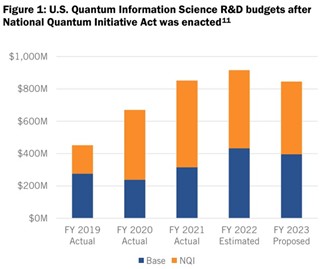
Image Credits - https://www2.datainnovation.org/2023-us-quantum-policy.pdf
The United States ' long-standing supremacy in quantum technology – a bedrock of U.S. economic and national security – is in peril at an important inflexion point. Quantum technologies are rapidly nearing market readiness, and the U.S. adversaries are more determined than ever to beat the United States to the quantum punch.
But the change in administration shapes a brighter future. The incoming Trump Administration can seize the moment by fully resourcing the Tech Hubs program, passing the NQI reauthorization, and leveraging the power of the United States' alliances.[10]
The international scientific community advocates for research collaboration U.S. is increasingly decoupling from China. Notably, China’s recent advances in research are competitive, if not superior to those in the U.S. After a delay, the U.S. renewed its Science and Technology Cooperation Agreement with China (STA) in 2024.
As the field of Quantum Information Science and Technology continues to evolve, the U.S. finds itself increasingly reliant on Chinese resources. It is also important for the U.S. to avoid imposing rigid quantum standards, allowing the industry and evolve naturally. There is a need for necessary export controls to protect the U.S. advancements in the Quantum computing field. By balancing strategic investment, innovation, and security, the United States can ensure it remains at the forefront of the quantum technology race.
The National Quantum Initiative Act was originally authorised with funding through 2029, and is currently under reauthorization efforts in 2025 to extend its mandate through December 2034. The reauthorization aims to sustain and expand federal quantum research and development programs, emphasising practical quantum technology applications and strengthening U.S. leadership in global quantum competition, especially from China.
In early May 2025, Congress held hearings with industry leaders from Microsoft, Google, and others, who testified on the critical role of the NQI in bridging government-funded quantum sciences research to market-ready applications. They stressed that continued funding and expanded partnerships across federal agencies like DOE, DoD, and NASA are essential for maintaining the U.S. competitive advantage. The reauthorization bill proposes approximately $2.7 billion in total federal investment over the next five years to accelerate research, workforce training and infrastructure development.
Technological Initiatives –
In 2024, the United States Department of Commerce added Origin Quantum Computing Technology (Hefei), commonly known as Origin Quantum, to its entity list, which also restricted U.S. companies and individuals from exporting specific technologies, equipment or components to Origin Quantum without a license, which is generally subject to presumption of denial.
Origin Quantum was included for allegedly acquiring or attempting to acquire U.S.-origin items to enhance China’s quantum capabilities as a part of a broader U.S. effort. Efforts to counter advancements in China’s quantum technology sector.
The U.S. government has articulated concerns related to National Security, particularly in the context of military applications of quantum technologies. The concern is encapsulated in a broader set of restrictions aimed at China’s quantum, aerospace and defence sectors.
Quantum Technologies and India’s defence architecture –
India’s quantum efforts have historically been led by individual researchers and academic institutions, with a strong focus on fundamental science rather than technology development and commercialisation.
With a rich legacy in theoretical physics, leading universities and research institutes have long engaged in quantum information science, quantum computation, and related areas, with over 170 professors actively working in quantum technology domains. In recent years, start-up activity has emerged, particularly in quantum software, algorithms, and quantum-safe cryptography, though these ventures have largely been bootstrapped or received limited seed funding.
The DST’s Quantum-Enabled Science and Technology (QuEST) program has provided some funding support, while early-stage efforts in quantum hardware— such as superconducting qubits, trapped ions, and photonics—have remained small in scale.[11]
India launched the National Quantum Mission (NQM) approved in April 2023 with a budget of about ₹6,003 crore (approximately $730 million), spanning from 2023-24 to 2030-31. This mission aims to position India as a global leader in the quantum computing field, developing capabilities within various subsectors of Quantum computing.
The National Quantum Mission is a nationwide initiative driving cutting-edge advancements in quantum technology. As part of this mission, four Thematic Hubs (T-Hubs) have been set up, bringing together 14 Technical Groups across 17 states and 2 Union Territories.
These hubs focus on technology innovation, skill development, entrepreneurship, industry partnerships, and global collaborations, ensuring a truly national impact. Women scientists from every corner of the country are actively encouraged to participate and benefit from the mission’s exciting programs.
The four IT-Hubs have been established across leading institutions in India:
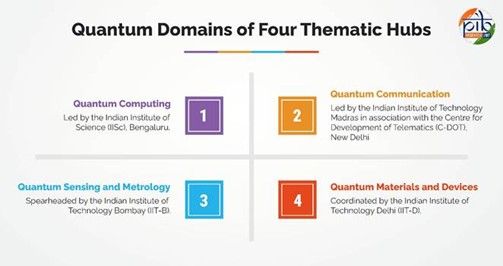
Image Credits - https://www.pib.gov.in/pressnotedetails.aspx?noteid=153963&moduleid=3&ref=drishtikone.com
Economic Competitiveness of India’s Quantum Policy –
India’s economic competitiveness in the quantum technology sector is rapidly strengthening, underpinned by a comprehensive national initiative, government funding and strategic efforts to foster ecosystem development.
Quantum technologies are projected to add $280-$310 billion to the Indian economy by 2030 through value creation across various sectors, including manufacturing, high-tech, banking, and defence.
As per the senior industry officials, the quantum ecosystem in India is growing at an accelerated pace with 10-15 government agencies, 20-30 service providers, 15-20 startups and 40-50 academic institutions active in the domain. The Indian quantum computing market generated $68.7 million in 2024 and is expected to reach $231.8 million by 2030 with a CAGR of 22.9% from 2025 to 2030.
A recent paper published by NITI Aayog Frontier Tech Hub (NITI-FTH), in collaboration with the Data Security Council of India, emphasises the need for a multi-prolonged strategy to harness the potential of quantum computing. The paper explores the rapid evolution of quantum technologies and their implications for India’s national security, technological leadership and economic competitiveness.
Furthermore, the paper stresses that technological leadership will require more than public investment alone. It calls for deep collaboration among government agencies, industry players and academic institutions, supported by a flexible innovation strategy, supply chain security and international partnerships.
It also describes that India must align its ambitions with long-term strategic imperatives. With over 30 governments globally pledging upwards of $40 billion for quantum development, India’s ability to secure its position will depend on timely execution, agile policymaking, and cross-sectoral cooperation.
India–Taiwan Collaboration –
India and Taiwan are increasingly recognising quantum computing as a strategic frontier with profound implications for national security, the economy, and technological sovereignty. Both Nations have made significant developments in quantum research, with Taiwan focusing on and advancing semiconductor-driven quantum hardware development, and India emphasising software algorithms, cryptography, and quantum communications. Taiwan has already demonstrated prowess in quantum computing. In January 2024, Academia Sinica launched Taiwan’s first indigenously built quantum computer, consisting of five superconducting qubits.
In October 2024, a research team led by the Department of Physics at the National Tsing Hua University (NTHU) developed the world’s smallest quantum computer using a single photon. Furthermore, in November 2024, the Taiwan Semiconductor Research Institute (TSRI), a government-funded institute under the National Applied Research Laboratories (NARLabs), acquired a 5-qubit superconducting quantum computer, the IQM Spark, from IQM Quantum Computers (IQM), a Finnish quantum computing company.
Taiwan is also pursuing quantum computing software and simulation through a strategic partnership between the Hon Hai Research Institute and Japan’s QunaSys. [13]The collaboration between India and Taiwan is underpinned by complementary strengths. Taiwan’s leadership in semiconductor development and chip manufacturing is critical for advancing scalable quantum hardware, particularly semiconductor qubits and photonic systems.
In contrast, India contributes through its expertise in algorithms, cryptography and workforce development, supported by the National Quantum Mission on Quantum Technologies and Applications.
The partnership between both countries aligns with broader geopolitical objectives, and it can also act as a counterbalance to technological dominance, such as China and the United States. It strengthens supply chain resilience, fosters academic and industrial cooperation and can enhance capabilities in quantum secure communications and cryptography, critical for cyber defence and economic security.
Policy Recommendations and the Way Forward -
India must adopt a comprehensive quantum computing strategy to develop an indigenous, quantum-resilient future.
The Niti Aayog’s Quarterly Future Front report (March 2025) highlights the importance of quantum computing and its impact on national security, economic growth and global competitiveness.
As per the report, Quantum technologies will play a defining role in securing critical infrastructure, strengthening defence capabilities, and safeguarding our digital sovereignty. It aims for a multi-pronged strategy encompassing deep collaboration between government, industry, and academia, through investment in indigenous capabilities.
First, India must assemble a Quantum Intelligence and Preparedness Task Force as an apex body to continuously monitor global developments in the quantum technology domain, evaluate capabilities of its competitors and adversaries and identify vulnerabilities across multiple sectors, including defence, AI, economy and energy infrastructure.
Secondly, there should be a shift to post-quantum cryptography (PQC) as a national priority to counter future cyber threats. The shift should be guided by specific assessments of vulnerabilities across various sectors supported by flexible cryptographic systems. As there are advances in quantum decryption, India must move sensitive communication networks, government systems, and military systems to PQC. This transition, as discussed in the NITI Aayog ‘s report, focuses on prioritising risks, testing new ideas and sharing knowledge across important sectors.
Third, while India has made significant progress through its National Quantum Mission, a strategic framework is crucial for effectively navigating the associated opportunities and challenges to enhance quantum computing and security preparedness. Key advancements in qubit stability, error correction and quantum software are imperative to progress in the domain. India must brace for two potential scenarios –
Fourth, India must integrate quantum technologies into next-generation military hardware. The technology will improve logistics, resource management, and help shape strategies during battles, making military operations more effective. Quantum-enabled AI, or Quantum AI, will support autonomous weapons systems like drones, robots, which will bolster offensive military capabilities.
The ability to scale qubits to millions, as suggested by the topology qubit, could enhance their defence, which means creating quantum sensors for accurate navigation, detecting stealth aircraft and other objects and simulating complex scenarios.
Fifth, India must engage in bilateral partnerships to prioritise pathways for technology access to scalable quantum modalities, including topological silicon spin and neutral atomic architectures. Technology access agreements, especially through forums like Quad, must aim to secure upstream components, cryogenic platforms and semiconductor-grade materials and supply chain partnerships.
Lastly, there is a dire need to expand both state and central funding to accelerate, support startups, and build quantum labs with the latest equipment at the disposal of the researchers and strengthen indigenous hardware and software capabilities. Support incubators, “quantum challenge” competitions and transnational research projects to spur development and commercialisation.
The Role of Regional Alliances in Countering China’s Quantum Technology Advancements –
The United States and China acknowledge the strategic advantages that quantum technologies present for military applications. Innovations such as quantum sensing, quantum cryptography, and quantum-enhanced cyber operations are poised to significantly augment situational awareness, refine battlefield precision, and optimise decision-making processes in conflict scenarios. These advancements may contribute to a heightened competitive dynamic, particularly in the Indo-Pacific region.
The Quadrilateral Security Dialogue, commonly known as the Quad, has become a cornerstone of Indo-Pacific security alliance strategies. Comprising four democratic nations – Australia, the US, India, and Japan – this alliance represents a shared vision for a free, open, and inclusive Indo-Pacific region. As we witness the rising influence of China in the area, the Quad’s importance has grown exponentially, serving as a counterbalance to maintain regional stability.
In the realm of defence modernization Asia Pacific, technology and innovation are at the forefront. The Quad alliance recognizes the critical role of cutting-edge technologies in maintaining a strategic advantage. From artificial intelligence and quantum computing to space technology and cybersecurity, the member nations are pooling their resources and expertise to stay ahead of the curve.
Australia’s participation in the AUKUS agreement is a prime example of this focus on technological advancement. The nuclear propulsion technology being shared under this pact represents a significant leap forward for Australia’s defense capabilities. Moreover, it opens avenues for further collaboration in areas such as artificial intelligence, quantum technologies, and undersea capabilities. [14]
In recent years, the United States has implemented a strategy of “integrated deterrence” in the Indo-Pacific region aimed at mitigating large-scale military conflicts. Integrated encompasses a coordinated approach to leveraging both existing and emerging capabilities in a networked manner. This involves the deployment of advanced weapon systems, enhanced communications networks, and cutting-edge technologies to dissuade adversaries from engaging in aggressive manoeuvres.
Notably, quantum technologies are increasingly becoming integral to this overarching integrated deterrence framework, particularly as China accelerates its advancements in quantum capabilities, including the development of weaponised quantum technologies, positioning itself as a significant competitor in this critical domain.
The AUKUS alliance’s collaboration in quantum science, alongside advancements in AI and robotics R&D, could pave the way for the creation of several prototypes intended for sea trials and performance evaluation. Arthur Herman, a senior fellow at the Hudson Institution and director of Quantum Alliance Initiative, emphasised that quantum sensing holds transformative potential for submarine warfare operations, applicable to both manned and unmanned vessels.
The Quad aims to strengthen its quantum ecosystem by addressing challenges like talent shortages and promoting cross-border startup ecosystems and joint funding programs. The Quad fellowship program, which brings STEM students to the U.S. for graduate degrees, can be leveraged for quantum-relevant disciplines.
AUKUS emphasises the development of military-oriented quantum technologies and seeks to achieve deep technological integration among its member nations. In contrast, the QUAD serves as a comprehensive framework for collaboration on a wider range of critical and emerging technologies, including quantum computing, intending to foster a more resilient and advanced technological landscape in the Indo-Pacific region. Both alliances are essential components of a strategic response to China’s accelerated progress in the quantum domain.
Conclusion –
Quantum supremacy refers to a milestone where a quantum computer can perform computational tasks that are impractical for any supercomputer to perform. The global race for quantum supremacy is dominated by China and, United States, with significant efforts made by the EU, Japan, India, etc.
As with cyber, nuclear and AI technologies, dominance in quantum computing also invites a possibility for arms races as the technology will progress; this dynamic intensifies pressure for new diplomatic frameworks, alliances, and treaties aimed at quantum technology controls similar to nuclear proliferation.
India needs to enhance its quantum ambitions through comprehensive frameworks, regional and international partnerships. The NQM provides a vital foundation, but the realisation of technological leadership will require greater private sector participation, agile funding models, and focused transnational research strategies. Partnership with Taiwan and Quad-based initiatives.
Geopolitical risks from quantum breakthroughs require prompt action on quantum-resilient infrastructure, especially in critical sectors. Prioritising post-quantum cryptography, boosting crypto agility and establishing a quantum risk assessment system are essential.
As the world approaches Q-Day – the threshold of cryptographically relevant quantum computing, India needs to act strategically. Quantum supremacy must not be left simply as a geopolitical fate; instead, it needs to be shaped with a planned strategy and vision rooted in innovation and security.
Bibliography –
Endnotes
Quantum technology is founded on the principles of quantum mechanics, the laws of physics governing subatomic particles. One of the primary applications of quantum technology today is quantum computing, which processes data in fundamentally different ways compared to conventional computers. Quantum physics is the “study of matter and energy at the most fundamental level.” Quantum technologies leverage the unique properties described by quantum physics to introduce new capabilities in computing, communications and sensing.
As quantum computing, communication and sensing capabilities mature, they promise to revolutionise national security architecture, disrupt cybersecurity paradigms and reshape global power hierarchies. The article examines the strategic implications of quantum technology innovations within the context of escalating geopolitical rivalries, with a particular focus on its military applications in the Indo-Pacific region, a key arena for geopolitical competition. It focuses on China’s aggressive pursuit of quantum-enabled defence capabilities and its broader ambition to assert technological and military dominance.
Keywords – Quantum computing, cybersecurity, geopolitics, national security
Research Questions –
- In what ways has China's National Laboratory for Quantum Information Sciences affected US quantum policy responses since 2020?
- What are the strategic and operational implications of quantum-secured communication technologies for the modernisation and resilience of India’s defence architecture?
- What role do regional alliances (e.g. Quad, AUKUS) play in countering China’s Quantum technology advances?
Review of Literature –
Khyati Singh, in her article entitled “Quantum Computing in Asia” (2024), presents a comprehensive assessment of the state of quantum computing across several Asian nations, focusing on technological development, national strategies, and geopolitical implications. The study identifies the region's leading actors - namely China, Japan, South Korea, and India- and evaluates their respective investments, institutional frameworks and international collaborations.
It suggests that the race for quantum supremacy could destabilise traditional deterrence models, especially in cyber and space domains. This aligns with existing theoretical frameworks in security studies that warn about quantum disruptions in intelligence, encryption and surveillance.
Elsa B. Kania in her paper entitled “China’s Strategic Ambiguity and Quantum Technology” (2018) provides a detailed analysis of China’s strategic approach to emerging technologies particularly quantum technology, within the broader context of great power competition with the U.S. Drawing from historical, political and strategic perspectives, the article frames China’s technological ambitions as a response to historical vulnerabilities and as a core element of its national rejuvenation campaign.The literature reflects a growing consensus that China’s techno-nationalism, driven by policies of Indigenous innovation, strategic military-civil fusion and tightly integrated party-state control, has placed it on a trajectory to challenge U.S. leadership in disruptive technologies, including quantum computing and quantum communications. Kania also situates China’s quantum strategy within broader statecraft, highlighting its integration with initiatives like the Digital Silk Road and its efforts to shape global standards and norms.
Frank Arute et al. in their article titled “Quantum Supremacy Using a Programmable Superconducting Processor” (2019) focus on the experimental demonstration of quantum supremacy—the milestone at which a quantum computer can perform a task that is infeasible for any classical supercomputer. The authors employed a 53-qubit superconducting processor, known as Sycamore, to execute a random quantum circuit sampling task in approximately 200 seconds, an endeavour they estimate would take 10,000 years on a cutting-edge supercomputer.
This study contributes to the existing literature by not only validating the correctness of the computation through classical simulation, where applicable, but also by introducing cross-entropy benchmarking to estimate fidelity in contexts beyond classical validation.
Shalaev et al. (2025) in their article entitled Photonic Networking of Quantum Memories in High-Dimensions, present an experimental advancement in quantum networking by demonstrating entanglement between high-dimensional quantum memories or qudits using single atoms and time-bin-encoded photons. Unlike conventional quantum networks that rely on two-level systems (qubits), this study uses qudits to expand the information-carrying capacity of quantum networks.
In a geopolitical context, this paper will help provide insights about advances in quantum networking underpinning secure communication networks, which are strategic assets for national security and can shift the balance of power in cyber and military domains.
Huang Jhon Preskill et al. (2022) in their article “Quantum Advantage in Learning from Experiments” explore the concept of quantum advantage in experimental learning tasks, demonstrating that quantum-enhanced approaches can significantly outperform classical methods in extracting information from physical systems.
The study introduces three classes of learning tasks – predicting physical properties, performing the quantum principal component analysis (PCA) and modelling physical dynamics where quantum systems show exponential gains in efficiency. Using 40 superconducting qubits on Google’s sycamore quantum processor, the authors conduct proof–of–principal experiments validating these theoretical predictions even under noisy conditions.
The study confirms that quantum systems can perform accurate learning with far fewer experimental repetitions, making them suitable for near-term applications in quantum sensing and machine learning.
Prateek Tripathi, in his article entitled “Quantum Technology: Exploring India-Taiwan Cooperation”, explores the nascent yet strategically significant collaboration between India and Taiwan in the field of quantum computing. The article situates this cooperation within broader geopolitical and technological contexts, especially amidst increasing export controls and a global push for supply chains independent of China.
The article also highlights India’s National Quantum Mission (NQM), which aims to develop indigenous capabilities in quantum computing, sensing, communications and materials. The potential cooperation between the two countries is highlighted by Taiwan’s semiconductor expertise and India’s advances in quantum sensing and communications. Tripathi advocates for structured engagements through academic exchanges, joint R&D programs, and private sector collaborations, building upon- India-Taiwan Science and Technology program.
Research Methodology -
In this research article, qualitative research methods have been used. The research primarily uses secondary data, which includes peer-reviewed journal articles (e.g. Arute et al., 2019; Shalaev et al., 2025), policy papers and strategic reports, expert reports, and think tank publications (e.g. Brookings Institution, CSET, and RAND). The article aims to assess the intersection of quantum technologies with national defence, applying a geopolitical perspective to discuss how emerging quantum technologies influence the balance of power, specifically in the Indo-Pacific theatre.
Introduction –
Quantum technologies represent a broad set of emerging innovations that exploit principles of quantum mechanics to surpass the limitations of classical systems. Key domains in the field include Quantum computing which utilises quantum bits (qubits) and phenomena such as superposition and entanglement to perform complex computations more efficiently; quantum cryptography, which applies quantum principles to enable secure key distribution and encryption; and quantum communication, which leverages quantum states to transmit information, offering the potential for inherently secure communication channels.
Quantum Computing –
Quantum computing is an emerging field at the intersection of computer science and quantum physics, aiming to solve problems currently intractable for classical supercomputers. It encompasses various subfields, including the development of quantum hardware and the design of quantum algorithms. Although still in its early stages, quantum computing holds the potential to outperform classical systems in solving complex computational tasks, particularly those requiring exponential resources or time.
A foundational understanding of quantum computing requires familiarity with four key principles of quantum mechanics – superposition, entanglement, decoherence and interference.
- Superposition – It refers to the ability of a quantum system to exist simultaneously in multiple states until it is measured. Unlike classical bits, which represent 0 or 1, quantum bits (qubits) can represent a combination of both states simultaneously.
- Entanglement - It describes a quantum phenomenon where particles become interlinked such that the state of one particle directly influences the state of another, regardless of the distance between them. This correlation exceeds what is possible through classical probability.
- Decoherence – It is the process by which a quantum system loses its quantum properties, typically due to interaction with the environment, causing it to transition into a definite classical state that can be measured.
- Interference - It allows quantum states to combine in ways that amplify or diminish certain outcomes. This principle enables quantum algorithms to enhance the probability of correct results while reducing the likelihood of incorrect ones.
Unlike classical computers, which use binary bits (0s and 1s) to store and process information, quantum computers use qubits, which can exist in a superposition of states. A qubit can represent a 0 or 1, or any weighted combination of both simultaneously. This property allows quantum systems to encode and process significantly more information in parallel. For example, two classical bits can represent one of four possible combinations simultaneously. As more qubits are added, the system’s computational capacity grows exponentially.
Despite this parallelism, each qubit yields only a single classical outcome upon measurement. Therefore, quantum algorithms are designed to manipulate qubits in ways that enhance the probability of obtaining correct results when measured. Exploring and interfering with multiple computational pathways simultaneously enables quantum algorithms to achieve potential speedups over classical methods for specific problem classes.
Quantum Cryptography –
Quantum cryptography, also called quantum encryption, encompasses a range of cybersecurity techniques that leverage the fundamental principles of quantum mechanics to secure data transmission. Unlike traditional cryptographic systems, which rely on mathematical complexity for security, quantum cryptography is grounded in the immutable laws of physics.
This distinction offers a new paradigm for information security, particularly through protocols such as Quantum Key Distribution (QKD), which enables the detection of any eavesdropping attempts on communication channels. As quantum computing advances, traditional cryptographic methods become vulnerable. Quantum cryptography, particularly QKD, ensures that any interception attempt is detectable, safeguarding data both against classical and quantum attacks. QKD facilitates the secure distribution of cryptographic keys, a critical component in digital payment security. This ensures that encryption keys remain confidential and integral, preventing unauthorised access and fraudulent transactions. [1]
Global Landscape of Quantum Development –
The development of quantum technology has emerged as a highly competitive domain within advanced technological innovation, with significant geopolitical and strategic implications. In this global quantum technology race, China and the United States have positioned themselves at the forefront, investing billions of dollars and R&D into accelerating the progress in this field. This technological rivalry is not just scientific; it can have profound consequences for global cybersecurity, economic competitiveness and national defence.
A critical milestone in this trajectory is the anticipated Q-Day – a hypothetical point in time when quantum computers will become capable of breaking widely used classical encryption methods. As this threshold approaches, the urgency to achieve quantum resilience in digital infrastructure continues to grow, reinforcing the strategic nature of quantum innovation on the global stage.
The prospect of future quantum decryption capabilities has prompted the emergence of harvest now and decrypt later strategies, wherein state and non-state actors collect encrypted data today, intending to decrypt it once quantum computing becomes sufficiently advanced.
In this context, China has launched state-backed initiatives such as the Micius satellite and the Beijing-Shanghai Quantum Communication Backbone, which aim to develop a quantum-secure communication infrastructure. Meanwhile, the U.S. has prioritised the development of post-quantum cryptography standards, particularly through the efforts of the National Institute of Standards and Technology (NIST)
The race to achieve cryptographically relevant quantum computing (CRQC) carries significant strategic implications. The first nation to reach this milestone may acquire substantial asymmetric intelligence advantages, potentially undermine current global security frameworks and alter the balance of power in cyberspace and beyond.
The United States' overall scientific research output in quantum information science is broad, stable, and at or near the global forefront in every application domain. The United States has a very broad base of academic research, with over 1,500 research institutions producing more than 10,000 papers over the past decade (focusing on quantum computing most, then communications, then sensing).
Publishing in all three domains has a steady growth of around 12 per cent per year. For the output of publications with high scientific impact (as quantified by academic citations), the United States is first in the world in the domains of quantum computing and sensing, and second (after China) in quantum communications. Its research is highly international, with about half of all publications being international collaborations. [2]
The United States leads in demonstrated technical capability in quantum computing and sensing, but not in quantum communications. Until recently, the United States was the clear technical leader in every scientific approach to quantum computing. In late June 2021, a Chinese research group claimed technical performance comparable to the United States in one of the leading scientific approaches (based on superconducting qubits), but their claims are still undergoing peer review as of August 2021.
The United States remains the clear leader in most other approaches to quantum computing and also leads in the deployment of quantum sensing. But its R&D remains primarily academic, and the United States lags in deployment, possibly because the only quantum communications application demonstrated so far, quantum key distribution, does not have any clear utility. 2
Chinese reports of total government R&D funding for quantum technology are wildly conflicting, with publicly reported estimates ranging from $84 million per year to almost $ billion per year. The authors were unable to determine from public sources whether the Chinese government is spending more or less than the U.S. government on quantum R&D is concentrated in government-funded laboratories, which have demonstrated rapid technical progress.
Over the past few years, R&D has become heavily concentrated in a single national laboratory in the city of Hefei, which Chinese-language news reports claim is receiving massive funding. By contrast, private firms appear to be much less important players in the Chinese QIB.2
Global Investments in Quantum Technologies –
In 2023, there was an overall decline in private investments, led by the U.S., following a record year in 2022. This decrease was largely due to a surge in Special Purpose Acquisition Company (SPAC) activity and larger funding rounds worldwide in 2022. In 2023, global private investments returned to pre-COVID-19 pandemic levels, totalling approximately 1.2. billion in Venture Capital (VC) investments (compared to US$2.4 billion in 2022).[3]
- The Asia Pacific (APAC) region maintained a stable growth trend in private investments, accounting for 18% of global private funding, with 217 million invested in 2023.
- Europe, Middle East, and Africa (EMEA) region saw a modest increase in private investments (~2.5%), reaching US$781 million. This growth was supported by a diverse funding landscape, including quantum-focused venture capital firms like Quantonation, early-stage deep-tech investors such as OpenOcean, and corporate venture arms like Airbus Ventures.
- The Americas experienced a significant decline in venture funding, with investments dropping by approximately 80%, totalling US$240 million.
Globally, an increasing number of governments are launching sovereign quantum initiatives to foster innovation and secure technological leadership. In the Asia–Pacific (APAC) region, several countries have recognised quantum technologies as strategic infrastructure critical to achieving technological autonomy and building competitive, integrated quantum ecosystems.
Japan emerged as an early adopter, introducing a national quantum strategy in 202, followed by South Korea in 2021. In 2024, Singapore announced a commitment of over USD 200 million over five years to support quantum research and talent development.
Australia also underscored its focus on quantum innovation through the launch of its National Quantum Strategy in 2023, aimed at enhancing its internationally recognised capabilities in quantum research and development.
China’s National Laboratory for Quantum Information Sciences and Its Influence on U.S. Quantum Policy Post-2020 –
The U.S. National Quantum Initiative Reauthorization Act is anticipated to be enacted, the act, which was originally established in 2018. The reauthorisation focuses on accelerating quantum-enabling research and development across the U.S., specifically focusing on practical applications and addressing the “valley of death” between research and commercialisation. The reauthorization act is also intended to cultivate a stronger domestic workforce through quantum education and training. The initiative will be jointly overseen by the Department of Energy (DOE) and the National Science Foundation, with support from the National Institute of Standards and Technology (NIST) and the National Aeronautics and Space Administration.
As the international scientific community advocates for research collaboration, the U.S. is increasingly decoupling from China on geopolitical grounds. Yet China’s recent research achievements rival, if not surpass, those of the U.S. After some delay, the U.S. renewed its Science and Technology Cooperation Agreement (STA) with China in December 2024 for another five years; the narrowed-down pact covers basic science but excludes collaboration on critical and emerging technologies.
The U.S. might have little choice but to depend on China as the field of QIST (quantum information science and technology) advances. After all, China is both a home to and a supplier of critical elements necessary for developing next-generation quantum technologies, especially in sourcing these materials and advancing the fundamentals of QSINT scientific research. [4]
National Laboratory for Quantum Information Sciences –
In China, the advancement of high-end quantum computing and related technologies is primarily a state-led and controlled initiative. Quantum technology has been designated as a strategic priority in China’s 14th Five-Year Plan (2021-2026). In October 2020, President Xi Jinping emphasised the importance and urgency of accelerating progress in quantum science and technology, framing it as essential for national competitiveness and security.
China has made notable strides in the field, particularly in quantum communication, where it is often viewed as having achieved parity with, or even surpassed, the U.S. A key milestone was the launch of the Micius satellite in 2016, which enabled groundbreaking space-based experiments in quantum communication.
In 2017, the Chinese government announced the establishment of a USD 10 billion National Laboratory for Quantum Information Sciences, which later developed Jiuzhang. This experimental quantum computer demonstrated quantum computational advantage in photonic systems. China’s National Laboratory for Quantum Information Sciences represents a flagship initiative in the country’s quantum research landscape. It is designed to serve as a national centre of excellence. For advancing both theoretical and applied aspects of quantum technology. The laboratory focuses on integrating fundamental research with practical applications, positioning China at the forefront of global quantum innovation.
The National Laboratory for Quantum Information Sciences, on the other hand, is a separate, large-scale government laboratory located in Hefei, Anhui Province. It includes the Anhui Quantum Computing Engineering Research Centre and the Hefei National Laboratory for Physical Sciences at the Microscale. The University of Science and Technology of China plays a pivotal role as a national leader in quantum research and education.
Technological Initiatives –
China has emerged as a global leader in the development and implementation of quantum encryption and cryptography, particularly in quantum communications. Over the past decade, the country has conducted the world's most extensive quantum communication networks.
These initiatives are primarily based on QKD. Its core advantage lies in its provable security: any attempt at eavesdropping disrupts the quantum states being transmitted, thereby revealing the presence of an intruder.
Recognising its strategic importance, China has integrated quantum cryptography into its broader national science and technology agenda, elevating it to the status of a critical state-level project. [5]
China has marked a significant advancement in its quantum computing capabilities with the launch of its third-generation superconducting quantum computer, Origin Wukong, developed by Origin Quantum Computing Technology in Hefei. The Wukong system is built around a 72-qubit superconducting chip with a total of 198 physical qubits comprising 72 operational qubits and an additional 126 qubits.
These couplers are specifically engineered to enhance qubit connectivity and enhance the accuracy of quantum gates. They do this by allowing adjustable interactions, which helps tackle issues like noise and interference. The system operates at cryogenic temperatures, housed within a dilution refrigerator to maintain quantum coherence.
In terms of performance metrics, the Wukong system reports a T1 (energy relaxation time) of 15.22 microseconds and a T2 (dephasing time) of 2.23 microseconds, with readout fidelity benchmarks aligning with globally competitive standards. Control and operational management of the system are enabled by Origin’s third-generation quantum control suite, known as Tianji, which supports automated batch testing, fast calibration routines, and uniform hardware performance.
Furthermore, Origin Quantum recently announced the development of Benyuan Tianji 4.0, its fourth-generation quantum computing control system, which is engineered to scale quantum operations to over 500 qubits. This upgrade is intended to support both enhanced system reliability and he transition to mass production capabilities. [6] When benchmarked against leading international systems, Wukong’s 72 qubit architecture with its innovative coupler design places it within the competitive range of platforms such as Google’s 105 qubit Willow Chip and IBM’s 156 qubit Heron 2.
Recently, researchers at University of Science and Technology of China have developed a superconducting quantum processor known as Zuxhongzhi 3.2, which successfully achieved quantum error correction below the fault-tolerance threshold, a key scientific benchmark in the field.
Researchers implemented a surface code error correction with a code distance of seven on a 107-qubit superconducting processor. They used an all-microwave control method, preferring a more efficient path than dominant approaches, which are predominantly used in the United States.
China’s ability to cross a key threshold indicates that it is moving towards fault-tolerant systems, which can accelerate applications in cryptography, sensing, materials design and potentially defence systems.
China’s Quantum Funding –
China’s commitment towards developing quantum technology is backed by significant public funding, although specifics remain unclear. Estimates indicate that China’s investments surpass $15 billion, significantly exceeding the U.S. allocation of $3.8 billion.[7] However, the true extent of China’s spending is challenging to ascertain due to a lack of transparency in government spending. Despite the doubts regarding its financial commitment, the country is positioning itself as a formidable competitor in the global quantum race.
Building on the momentum from the 13th Five-Year Plan, the 14th Plan intensifies China’s focus on quantum technology by laying out more specific and ambitious goals. It calls for the establishment of national laboratories dedicated to quantum information, a move designed to consolidate China’s leadership in this critical field. The plan prioritises the development of advanced quantum communication technologies across intra-city, inter-city, and free-space environments, alongside the creation of a general quantum computing prototype and a practical quantum simulator. [8]
The 14th Five-Year Plan indicates the accelerate the deployment of cutting edge technologies such as quantum computing, quantum communication, neural chips, and DNA storage, strengthen cross-disciplinary innovation in information science, life sciences, materials, and other basic disciplines, support the development of innovative consortia such as digital technology open source communities, improve open source IP and legal systems, and encourage enterprises to open up software source code, hardware designs, and application services.
In 2024, the Chinese Ministry of Industry and Information Technology (MIIT) designated quantum computing as a strategic “future industry” within its national industrial policy framework. The policy document emphasised advancing fault-tolerant quantum computing, alongside the development of robust quantum software ecosystems and cloud-based quantum platforms.
The MIIT advocated for a full-stack development model, similar to that of Origin Quantum. This approach reflects increasingly inward-focused innovation strategy prioritising technological sovereignty over reliance on international collaboration.
U.S. Response -
The scale of China’s investment, estimated at $15 billion in government funding in 2022, prompted the U.S. leaders to push for expanded domestic support. By May 2025, the quantum industry executives (e.g. from Google, Microsoft and PSI Quantum) testified before Congress, urging reauthorization of the National Quantum Initiative (NQI) to avoid falling behind rivals like China. This included calls for increased federal investment, workforce development and secure supply chains, reflecting concerns over China’s state-driven advancements centred on facilities like NLQIS.
The National Quantum Initiative Act (NQIA) catalysed a significant increase in federal funding for QIS (Quantum Information Sciences and R&D, roughly doubling federal funding between FY 2019 and FY 2023.
It is important to note that while NQIA sets funding targets and priorities for QIS (Quantum Information Sciences) R&D across various federal agencies, it does not guarantee specific funding amounts. The President and Congress set non-defence quantum R&D priorities and funding for each federal agency through an annual federal budget, with defence spending set through a separate bill called the National Defence Authorisation Act.
Figure 1 shows the U.S. R&D budgets for QIS (Quantum Information Sciences) since the inception of the NQIA, with agencies reporting actual budget expenditures for quantum R&D of $449 million in FY 2019, $672 million in FY 2020, and $855 million in FY 2021, followed by $918 million of enacted budget authority for quantum R&D in FY 2022 and a requested budget authority of $844 million for quantum R&D in FY 2023.
The portion of each bar in Figure 1 marked “NQI” identifies funding allocated for NQIA-authorized activities, meaning it is additional funding on top of the budgets for baseline QIS (Quantum Information Sciences) R&D activities.[9]
Image Credits - https://www2.datainnovation.org/2023-us-quantum-policy.pdf
The United States ' long-standing supremacy in quantum technology – a bedrock of U.S. economic and national security – is in peril at an important inflexion point. Quantum technologies are rapidly nearing market readiness, and the U.S. adversaries are more determined than ever to beat the United States to the quantum punch.
But the change in administration shapes a brighter future. The incoming Trump Administration can seize the moment by fully resourcing the Tech Hubs program, passing the NQI reauthorization, and leveraging the power of the United States' alliances.[10]
The international scientific community advocates for research collaboration U.S. is increasingly decoupling from China. Notably, China’s recent advances in research are competitive, if not superior to those in the U.S. After a delay, the U.S. renewed its Science and Technology Cooperation Agreement with China (STA) in 2024.
As the field of Quantum Information Science and Technology continues to evolve, the U.S. finds itself increasingly reliant on Chinese resources. It is also important for the U.S. to avoid imposing rigid quantum standards, allowing the industry and evolve naturally. There is a need for necessary export controls to protect the U.S. advancements in the Quantum computing field. By balancing strategic investment, innovation, and security, the United States can ensure it remains at the forefront of the quantum technology race.
The National Quantum Initiative Act was originally authorised with funding through 2029, and is currently under reauthorization efforts in 2025 to extend its mandate through December 2034. The reauthorization aims to sustain and expand federal quantum research and development programs, emphasising practical quantum technology applications and strengthening U.S. leadership in global quantum competition, especially from China.
In early May 2025, Congress held hearings with industry leaders from Microsoft, Google, and others, who testified on the critical role of the NQI in bridging government-funded quantum sciences research to market-ready applications. They stressed that continued funding and expanded partnerships across federal agencies like DOE, DoD, and NASA are essential for maintaining the U.S. competitive advantage. The reauthorization bill proposes approximately $2.7 billion in total federal investment over the next five years to accelerate research, workforce training and infrastructure development.
Technological Initiatives –
In 2024, the United States Department of Commerce added Origin Quantum Computing Technology (Hefei), commonly known as Origin Quantum, to its entity list, which also restricted U.S. companies and individuals from exporting specific technologies, equipment or components to Origin Quantum without a license, which is generally subject to presumption of denial.
Origin Quantum was included for allegedly acquiring or attempting to acquire U.S.-origin items to enhance China’s quantum capabilities as a part of a broader U.S. effort. Efforts to counter advancements in China’s quantum technology sector.
The U.S. government has articulated concerns related to National Security, particularly in the context of military applications of quantum technologies. The concern is encapsulated in a broader set of restrictions aimed at China’s quantum, aerospace and defence sectors.
Quantum Technologies and India’s defence architecture –
India’s quantum efforts have historically been led by individual researchers and academic institutions, with a strong focus on fundamental science rather than technology development and commercialisation.
With a rich legacy in theoretical physics, leading universities and research institutes have long engaged in quantum information science, quantum computation, and related areas, with over 170 professors actively working in quantum technology domains. In recent years, start-up activity has emerged, particularly in quantum software, algorithms, and quantum-safe cryptography, though these ventures have largely been bootstrapped or received limited seed funding.
The DST’s Quantum-Enabled Science and Technology (QuEST) program has provided some funding support, while early-stage efforts in quantum hardware— such as superconducting qubits, trapped ions, and photonics—have remained small in scale.[11]
India launched the National Quantum Mission (NQM) approved in April 2023 with a budget of about ₹6,003 crore (approximately $730 million), spanning from 2023-24 to 2030-31. This mission aims to position India as a global leader in the quantum computing field, developing capabilities within various subsectors of Quantum computing.
The National Quantum Mission is a nationwide initiative driving cutting-edge advancements in quantum technology. As part of this mission, four Thematic Hubs (T-Hubs) have been set up, bringing together 14 Technical Groups across 17 states and 2 Union Territories.
These hubs focus on technology innovation, skill development, entrepreneurship, industry partnerships, and global collaborations, ensuring a truly national impact. Women scientists from every corner of the country are actively encouraged to participate and benefit from the mission’s exciting programs.
The four IT-Hubs have been established across leading institutions in India:
- Indian Institute of Science (IISc) Bengaluru
- Indian Institute of Technology (IIT), Madras, in association with the Centre for Development of Telematics, New Delhi
- Indian Institute of Technology (IIT), Bombay
- Indian Institute of Technology (IIT), Delhi.
Image Credits - https://www.pib.gov.in/pressnotedetails.aspx?noteid=153963&moduleid=3&ref=drishtikone.com
Economic Competitiveness of India’s Quantum Policy –
India’s economic competitiveness in the quantum technology sector is rapidly strengthening, underpinned by a comprehensive national initiative, government funding and strategic efforts to foster ecosystem development.
Quantum technologies are projected to add $280-$310 billion to the Indian economy by 2030 through value creation across various sectors, including manufacturing, high-tech, banking, and defence.
As per the senior industry officials, the quantum ecosystem in India is growing at an accelerated pace with 10-15 government agencies, 20-30 service providers, 15-20 startups and 40-50 academic institutions active in the domain. The Indian quantum computing market generated $68.7 million in 2024 and is expected to reach $231.8 million by 2030 with a CAGR of 22.9% from 2025 to 2030.
A recent paper published by NITI Aayog Frontier Tech Hub (NITI-FTH), in collaboration with the Data Security Council of India, emphasises the need for a multi-prolonged strategy to harness the potential of quantum computing. The paper explores the rapid evolution of quantum technologies and their implications for India’s national security, technological leadership and economic competitiveness.
Furthermore, the paper stresses that technological leadership will require more than public investment alone. It calls for deep collaboration among government agencies, industry players and academic institutions, supported by a flexible innovation strategy, supply chain security and international partnerships.
It also describes that India must align its ambitions with long-term strategic imperatives. With over 30 governments globally pledging upwards of $40 billion for quantum development, India’s ability to secure its position will depend on timely execution, agile policymaking, and cross-sectoral cooperation.
India–Taiwan Collaboration –
India and Taiwan are increasingly recognising quantum computing as a strategic frontier with profound implications for national security, the economy, and technological sovereignty. Both Nations have made significant developments in quantum research, with Taiwan focusing on and advancing semiconductor-driven quantum hardware development, and India emphasising software algorithms, cryptography, and quantum communications. Taiwan has already demonstrated prowess in quantum computing. In January 2024, Academia Sinica launched Taiwan’s first indigenously built quantum computer, consisting of five superconducting qubits.
In October 2024, a research team led by the Department of Physics at the National Tsing Hua University (NTHU) developed the world’s smallest quantum computer using a single photon. Furthermore, in November 2024, the Taiwan Semiconductor Research Institute (TSRI), a government-funded institute under the National Applied Research Laboratories (NARLabs), acquired a 5-qubit superconducting quantum computer, the IQM Spark, from IQM Quantum Computers (IQM), a Finnish quantum computing company.
Taiwan is also pursuing quantum computing software and simulation through a strategic partnership between the Hon Hai Research Institute and Japan’s QunaSys. [13]The collaboration between India and Taiwan is underpinned by complementary strengths. Taiwan’s leadership in semiconductor development and chip manufacturing is critical for advancing scalable quantum hardware, particularly semiconductor qubits and photonic systems.
In contrast, India contributes through its expertise in algorithms, cryptography and workforce development, supported by the National Quantum Mission on Quantum Technologies and Applications.
The partnership between both countries aligns with broader geopolitical objectives, and it can also act as a counterbalance to technological dominance, such as China and the United States. It strengthens supply chain resilience, fosters academic and industrial cooperation and can enhance capabilities in quantum secure communications and cryptography, critical for cyber defence and economic security.
Policy Recommendations and the Way Forward -
India must adopt a comprehensive quantum computing strategy to develop an indigenous, quantum-resilient future.
The Niti Aayog’s Quarterly Future Front report (March 2025) highlights the importance of quantum computing and its impact on national security, economic growth and global competitiveness.
As per the report, Quantum technologies will play a defining role in securing critical infrastructure, strengthening defence capabilities, and safeguarding our digital sovereignty. It aims for a multi-pronged strategy encompassing deep collaboration between government, industry, and academia, through investment in indigenous capabilities.
First, India must assemble a Quantum Intelligence and Preparedness Task Force as an apex body to continuously monitor global developments in the quantum technology domain, evaluate capabilities of its competitors and adversaries and identify vulnerabilities across multiple sectors, including defence, AI, economy and energy infrastructure.
Secondly, there should be a shift to post-quantum cryptography (PQC) as a national priority to counter future cyber threats. The shift should be guided by specific assessments of vulnerabilities across various sectors supported by flexible cryptographic systems. As there are advances in quantum decryption, India must move sensitive communication networks, government systems, and military systems to PQC. This transition, as discussed in the NITI Aayog ‘s report, focuses on prioritising risks, testing new ideas and sharing knowledge across important sectors.
Third, while India has made significant progress through its National Quantum Mission, a strategic framework is crucial for effectively navigating the associated opportunities and challenges to enhance quantum computing and security preparedness. Key advancements in qubit stability, error correction and quantum software are imperative to progress in the domain. India must brace for two potential scenarios –
- Incremental Advancements – Gradual improvement in qubits, control systems, and algorithms.
- Disruptive Breakthroughs – Innovative platforms, such as silicon spin or topological qubits or breakthrough error correction techniques that significantly accelerate the quantum timeline.
Fourth, India must integrate quantum technologies into next-generation military hardware. The technology will improve logistics, resource management, and help shape strategies during battles, making military operations more effective. Quantum-enabled AI, or Quantum AI, will support autonomous weapons systems like drones, robots, which will bolster offensive military capabilities.
The ability to scale qubits to millions, as suggested by the topology qubit, could enhance their defence, which means creating quantum sensors for accurate navigation, detecting stealth aircraft and other objects and simulating complex scenarios.
Fifth, India must engage in bilateral partnerships to prioritise pathways for technology access to scalable quantum modalities, including topological silicon spin and neutral atomic architectures. Technology access agreements, especially through forums like Quad, must aim to secure upstream components, cryogenic platforms and semiconductor-grade materials and supply chain partnerships.
Lastly, there is a dire need to expand both state and central funding to accelerate, support startups, and build quantum labs with the latest equipment at the disposal of the researchers and strengthen indigenous hardware and software capabilities. Support incubators, “quantum challenge” competitions and transnational research projects to spur development and commercialisation.
The Role of Regional Alliances in Countering China’s Quantum Technology Advancements –
The United States and China acknowledge the strategic advantages that quantum technologies present for military applications. Innovations such as quantum sensing, quantum cryptography, and quantum-enhanced cyber operations are poised to significantly augment situational awareness, refine battlefield precision, and optimise decision-making processes in conflict scenarios. These advancements may contribute to a heightened competitive dynamic, particularly in the Indo-Pacific region.
The Quadrilateral Security Dialogue, commonly known as the Quad, has become a cornerstone of Indo-Pacific security alliance strategies. Comprising four democratic nations – Australia, the US, India, and Japan – this alliance represents a shared vision for a free, open, and inclusive Indo-Pacific region. As we witness the rising influence of China in the area, the Quad’s importance has grown exponentially, serving as a counterbalance to maintain regional stability.
In the realm of defence modernization Asia Pacific, technology and innovation are at the forefront. The Quad alliance recognizes the critical role of cutting-edge technologies in maintaining a strategic advantage. From artificial intelligence and quantum computing to space technology and cybersecurity, the member nations are pooling their resources and expertise to stay ahead of the curve.
Australia’s participation in the AUKUS agreement is a prime example of this focus on technological advancement. The nuclear propulsion technology being shared under this pact represents a significant leap forward for Australia’s defense capabilities. Moreover, it opens avenues for further collaboration in areas such as artificial intelligence, quantum technologies, and undersea capabilities. [14]
In recent years, the United States has implemented a strategy of “integrated deterrence” in the Indo-Pacific region aimed at mitigating large-scale military conflicts. Integrated encompasses a coordinated approach to leveraging both existing and emerging capabilities in a networked manner. This involves the deployment of advanced weapon systems, enhanced communications networks, and cutting-edge technologies to dissuade adversaries from engaging in aggressive manoeuvres.
Notably, quantum technologies are increasingly becoming integral to this overarching integrated deterrence framework, particularly as China accelerates its advancements in quantum capabilities, including the development of weaponised quantum technologies, positioning itself as a significant competitor in this critical domain.
The AUKUS alliance’s collaboration in quantum science, alongside advancements in AI and robotics R&D, could pave the way for the creation of several prototypes intended for sea trials and performance evaluation. Arthur Herman, a senior fellow at the Hudson Institution and director of Quantum Alliance Initiative, emphasised that quantum sensing holds transformative potential for submarine warfare operations, applicable to both manned and unmanned vessels.
The Quad aims to strengthen its quantum ecosystem by addressing challenges like talent shortages and promoting cross-border startup ecosystems and joint funding programs. The Quad fellowship program, which brings STEM students to the U.S. for graduate degrees, can be leveraged for quantum-relevant disciplines.
AUKUS emphasises the development of military-oriented quantum technologies and seeks to achieve deep technological integration among its member nations. In contrast, the QUAD serves as a comprehensive framework for collaboration on a wider range of critical and emerging technologies, including quantum computing, intending to foster a more resilient and advanced technological landscape in the Indo-Pacific region. Both alliances are essential components of a strategic response to China’s accelerated progress in the quantum domain.
Conclusion –
Quantum supremacy refers to a milestone where a quantum computer can perform computational tasks that are impractical for any supercomputer to perform. The global race for quantum supremacy is dominated by China and, United States, with significant efforts made by the EU, Japan, India, etc.
As with cyber, nuclear and AI technologies, dominance in quantum computing also invites a possibility for arms races as the technology will progress; this dynamic intensifies pressure for new diplomatic frameworks, alliances, and treaties aimed at quantum technology controls similar to nuclear proliferation.
India needs to enhance its quantum ambitions through comprehensive frameworks, regional and international partnerships. The NQM provides a vital foundation, but the realisation of technological leadership will require greater private sector participation, agile funding models, and focused transnational research strategies. Partnership with Taiwan and Quad-based initiatives.
Geopolitical risks from quantum breakthroughs require prompt action on quantum-resilient infrastructure, especially in critical sectors. Prioritising post-quantum cryptography, boosting crypto agility and establishing a quantum risk assessment system are essential.
As the world approaches Q-Day – the threshold of cryptographically relevant quantum computing, India needs to act strategically. Quantum supremacy must not be left simply as a geopolitical fate; instead, it needs to be shaped with a planned strategy and vision rooted in innovation and security.
Bibliography –
- Arute, F., Arya, K., Babbush, R., Bacon, D., Bardin, J. C., Barends, R., ... & Martinis, J. M. (2019). Quantum supremacy using a programmable superconducting processor. Nature, 574(7779), 505-510.
- https://www.qusecure.com/the-quantum-battle-for-the-indo-pacific-theater-intersections-of-technology-and-territory/
- Huang, H. Y., Broughton, M., Cotler, J., Chen, S., Li, J., Mohseni, M., ... & McClean, J. R. (2022). Quantum advantage in learning from experiments. Science, 376(6598), 1182-1186.
- Kania, E. B. 14Technology and Innovation in China’s Strategy and Global. China's Glo. bal Influence, 228.
- https://www.orfonline.org/expert-speak/quantum-technology-exploring-india-taiwan-cooperation
- https://www.globaltimes.cn/page/202512/1351319.shtml
- Krelina, M. (2021). Quantum technology for military applications. EPJ Quantum Technology, 8(1), 24.
- Omaar, H. (2023). The US Approach to Quantum Policy. In ITIF Center for Data Innovation.
- Parker, E., Gonzales, D., Kochhar, A. K., Litterer, S., O'Connor, K., Schmid, J., ... & Harold, S. W. (2022). An assessment of the US and Chinese industrial bases in quantum technology. Rand Corporation.
- Perrier, E. (2022). The quantum governance stack: Models of governance for quantum information technologies. Digital Society, 1(3), 22.
- QuSecure. (n.d.). The quantum battle for the Indo-Pacific theatre: Intersections of technology and territory. Retrieved from https://www.qusecure.com/the-quantum-battle-for-the-indo-pacific-theater-intersections-of-technology-and-territory/
- Shalaev, M., Saha, S., Toh, G., Goetting, I., Kalakuntla, A., Shi, H. B., ... & Monroe, C. (2025). Photonic Networking of Quantum Memories in High-Dimensions. arXiv preprint arXiv:2505.11704.
- Shekhar, V. (2023). Techno-geopolitics and US support for India’s quantum ambition.
- Singh, K. (2024). The Race for Quantum Technology in Asia. Defence & Diplomacy, 13(3), 77-88.
Endnotes
[1] https://www.theweek.in/news/sci-tech/2025/01/29/explained-how-quantum-cryptography-is-leveraging-principles-of-quantum-mechanics-to-secure-data-to-prevent-financial-frauds.html
[2] Parker, E., Gonzales, D., Kochhar, A. K., Litterer, S., O’Connor, K., Schmid, J., Scholl, K., Silberglitt, R., Chang, J., Eusebi, C. A., & Harold, S. W. (2022). An assessment of the U.S. and Chinese industrial bases in quantum technology. RAND Corporation. https://www.rand.org/pubs/research_reports/RRA869-1.html
[3] IQM, “State of Quantum 2024 Report”, 29 January 2024
[4] Nhon, L., & Kuehn, A. (2025). Navigating the entanglements in the U.S.-China quantum technology race. Observer Research Foundation. https://www.orfonline.org/expert-speak/navigating-the-entanglements-in-the-u-s-china-quantum-technology-race#_edn1
[5] https://postquantum.com/quantum-computing/china-quantum/#quantum-computing-chinas-current-advancements
[9] Omaar, H. (2023). The U.S. approach to quantum policy. Centre for Data Innovation.
About the Author:
Rajas Purandare is working as a Researcher at the Indic Researchers Forum. He holds a MA Hons. in International Relations & Strategic Studies from the University of Mumbai.
Note:
The research paper reflects the opinion of the author and not necessarily the views of the organisation.