
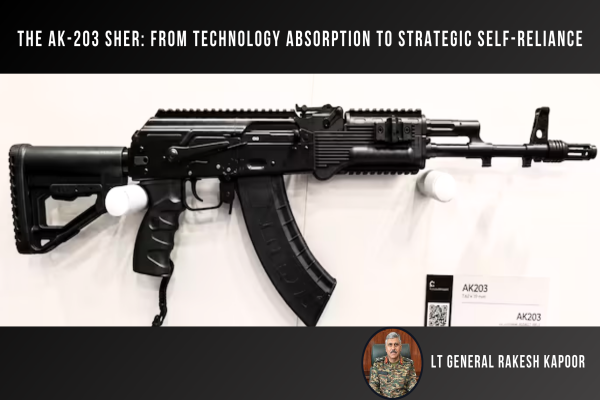
The AK-203 Sher: From Technology Absorption to Strategic Self-Reliance
September 03, 2026 Lieutenant General Rakesh Kapoor, PVSM, AVSM, VSM
The significance of the AK-203 Sher is not merely that India has manufactured another assault rifle. Its real significance lies in the capability that has been created behind the rifle, the capability to manufacture its components, sub-components and input materials domestically. The achievement encompasses 50 major components, 180 child parts and nearly 400 types of input materials, all produced entirely within India. This is an important milestone in India's journey towards defence self-reliance.
The successful test firing of the AK 203 Sher, is a manifestation of a much larger industrial ecosystem. It reflects capabilities in metallurgy, precision engineering, quality control and world-class testing. All contributed through skilled manpower, and a dependable supplier base with participation of a wide network of Indian MSMEs. The AK-203 Sher therefore represents much more than the production of a weapon system. It represents development of capabilities.
Atmanirbharta is also about mastering technology
There is an important dimension to Atmanirbharta that deserves attention. Indigenous technology must certainly remain a primary focus. But strategic self-reliance also requires the ability to understand, absorb and master technologies that originate elsewhere. The journey from technology acquisition to technology mastery is a critical one. The AK-203 Sher is a good example of how India's longstanding defence relationship with Russia has further evolved. Whilst the original design may be Russian. India has progressively developed the manufacturing ecosystem around it. The project demonstrates not simply technology transfer, but technology absorption and the creation of indigenous manufacturing capabilities.
This distinction matters. A country becomes strategically capable when it develops the capacity to understand that technology, absorb it, adapt it and ultimately manufacture the complete product independently.
Building capability beyond a single weapon
The true value of such a programme cannot be measured only by the number of rifles produced. Every defence manufacturing programme creates capabilities around itself, ie, metallurgy, precision engineering, machining, materials, quality assurance, testing and skilled manpower are all part of a larger ecosystem. The AK-203 programme has brought all these capabilities together through Indian industry and skilled manpower. Cumulatively, they contribute to the broader industrial base of the country and strengthen India's ability to manufacture other complex defence equipment. In this sense, the weapon becomes an instrument through which a much larger technological and industrial capability is created. Indigenous manufacturing therefore must be evaluated not simply in terms of the percentage of indigenous content, but also in terms of the capabilities and capacities created within the country.
Supply-chain resilience is a strategic imperative
There is another dimension to indigenisation that has direct implications for national security; In conflict scenarios, maintaining supply chains becomes a critical challenge. In prolonged conflicts military effectiveness depends not only on the weapon systems it possesses but also on its ability to sustain those weapons over time. External dependencies can become vulnerabilities when supply routes get disrupted or when international circumstances change.
Domestic manufacturing of components and input materials provides supply-chain sovereignty. A resilient defence industrial base gives the country greater confidence that equipment can be supported and sustained even under demanding circumstances.
The soldier and the environment remain the ultimate test
For a soldier, a rifle is not merely a piece of equipment, it is an extension of the soldier himself. The weapon must therefore be reliable in every condition in which the soldier is required to operate. India presents an exceptionally diverse operational environment. The Indian Army operates across glaciers and icy mountains, plains, deserts, salt pans and jungle terrain. A military weapon system intended for such an environment must be robust to perform reliably across these vastly different conditions.
Robustness to perform effectively in India's multi-terrain conditions is therefore an operational imperative. The indigenous manufacture of the AK-203 Sher has particular significance in this context, since it brings together three important components: operational reliability, supply-chain resilience and confidence in Indian manufacturing capabilities. For the soldiers deployed in a demanding environments, confidence in his weapon is inseparable from confidence in the system that produces, sustains and supports it.
From acquisition to ownership
India's defence transformation must also be understood as a transition from acquisition to ownership. While acquisition enhances military capability, Ownership gives the nation not only the ability to sustain but also capability of evolutionary development with every successive model. The AK-203 journey demonstrates this transition. This is precisely how strategic industrial capability is built—step by step, capability by capability. The lesson extends beyond the AK-203. India's defence industrial ambition is to create an ecosystem capable of absorbing contemporary technologies, developing indigenous expertise and eventually achieving complete mastery over the manufacturing process.
For the Indian industry, it means deeper technological capabilities and wide spread domestic capacities to manufacture, wherein the byproducts achieved may be utilised for other use cases. For the country, it represents something even more fundamental; the growing ability to rely on its own industrial strength when strategic circumstances demand it.
The real achievement of the AK-203 Sher is not simply that India can make another rifle. It is that India is increasingly developing the capacity to make what it needs, sustain what it fields and master the technologies on which its security depends.
The successful test firing of the AK 203 Sher, is a manifestation of a much larger industrial ecosystem. It reflects capabilities in metallurgy, precision engineering, quality control and world-class testing. All contributed through skilled manpower, and a dependable supplier base with participation of a wide network of Indian MSMEs. The AK-203 Sher therefore represents much more than the production of a weapon system. It represents development of capabilities.
Atmanirbharta is also about mastering technology
There is an important dimension to Atmanirbharta that deserves attention. Indigenous technology must certainly remain a primary focus. But strategic self-reliance also requires the ability to understand, absorb and master technologies that originate elsewhere. The journey from technology acquisition to technology mastery is a critical one. The AK-203 Sher is a good example of how India's longstanding defence relationship with Russia has further evolved. Whilst the original design may be Russian. India has progressively developed the manufacturing ecosystem around it. The project demonstrates not simply technology transfer, but technology absorption and the creation of indigenous manufacturing capabilities.
This distinction matters. A country becomes strategically capable when it develops the capacity to understand that technology, absorb it, adapt it and ultimately manufacture the complete product independently.
Building capability beyond a single weapon
The true value of such a programme cannot be measured only by the number of rifles produced. Every defence manufacturing programme creates capabilities around itself, ie, metallurgy, precision engineering, machining, materials, quality assurance, testing and skilled manpower are all part of a larger ecosystem. The AK-203 programme has brought all these capabilities together through Indian industry and skilled manpower. Cumulatively, they contribute to the broader industrial base of the country and strengthen India's ability to manufacture other complex defence equipment. In this sense, the weapon becomes an instrument through which a much larger technological and industrial capability is created. Indigenous manufacturing therefore must be evaluated not simply in terms of the percentage of indigenous content, but also in terms of the capabilities and capacities created within the country.
Supply-chain resilience is a strategic imperative
There is another dimension to indigenisation that has direct implications for national security; In conflict scenarios, maintaining supply chains becomes a critical challenge. In prolonged conflicts military effectiveness depends not only on the weapon systems it possesses but also on its ability to sustain those weapons over time. External dependencies can become vulnerabilities when supply routes get disrupted or when international circumstances change.
Domestic manufacturing of components and input materials provides supply-chain sovereignty. A resilient defence industrial base gives the country greater confidence that equipment can be supported and sustained even under demanding circumstances.
The soldier and the environment remain the ultimate test
For a soldier, a rifle is not merely a piece of equipment, it is an extension of the soldier himself. The weapon must therefore be reliable in every condition in which the soldier is required to operate. India presents an exceptionally diverse operational environment. The Indian Army operates across glaciers and icy mountains, plains, deserts, salt pans and jungle terrain. A military weapon system intended for such an environment must be robust to perform reliably across these vastly different conditions.
Robustness to perform effectively in India's multi-terrain conditions is therefore an operational imperative. The indigenous manufacture of the AK-203 Sher has particular significance in this context, since it brings together three important components: operational reliability, supply-chain resilience and confidence in Indian manufacturing capabilities. For the soldiers deployed in a demanding environments, confidence in his weapon is inseparable from confidence in the system that produces, sustains and supports it.
From acquisition to ownership
India's defence transformation must also be understood as a transition from acquisition to ownership. While acquisition enhances military capability, Ownership gives the nation not only the ability to sustain but also capability of evolutionary development with every successive model. The AK-203 journey demonstrates this transition. This is precisely how strategic industrial capability is built—step by step, capability by capability. The lesson extends beyond the AK-203. India's defence industrial ambition is to create an ecosystem capable of absorbing contemporary technologies, developing indigenous expertise and eventually achieving complete mastery over the manufacturing process.
For the Indian industry, it means deeper technological capabilities and wide spread domestic capacities to manufacture, wherein the byproducts achieved may be utilised for other use cases. For the country, it represents something even more fundamental; the growing ability to rely on its own industrial strength when strategic circumstances demand it.
The real achievement of the AK-203 Sher is not simply that India can make another rifle. It is that India is increasingly developing the capacity to make what it needs, sustain what it fields and master the technologies on which its security depends.
About the Author:
Lieutenant General Rakesh Kapoor, PVSM, AVSM, VSM, is a distinguished senior officer of the Indian Army. Retired as the Deputy Chief of the Army Staff (Information Systems & Training). He has held key command and staff appointments across diverse operational environments.
Note:
Share this article:
© Copyright 2026 Indic Researchers Forum | Designed & Developed By Bigpage.in