
25 Years of Trust: Putin’s Visit Marks a Milestone
December 03, 2025 Prof. Sheetal Arya
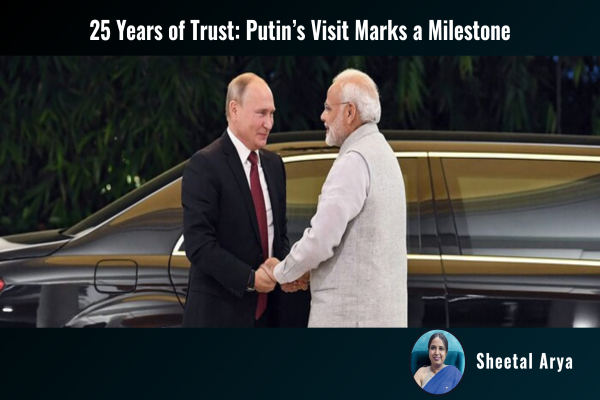
President Putin is going to attend the Russia- Indian Forum in the first week of December in New Delhi. This will mark first visit of President Putin to India since the onset of the Russia Ukraine war in 2021. Kremlin spokesperson Dmitry Peskov mentioned that Russia is “actively preparing” for the trip. Russian Ambassador Alipov also highlighted the intensive preparation of the visit with a comprehensive agenda encompassing nuclear, defence, power, space to education, technology. Central to this visit is the signing of the Labour Mobility Agreement that will ensure fair wages, transparent recruitment, and protection of workers’ rights for skilled manpower from India. It will not only provide legal protection to the Indian workers in Russia but holds the potential to expand Indian diaspora in Russia that may result in strengthening ties between both the countries beyond the traditional diplomatic channels.
One of the most crucial opportunities for India that this visit offers is the Arctic Accord. Russia views India as a time-tested friend and expresses its willingness for India to enter the Arctic geopolitics. It believes that India will be a stabilising factor in the region. The Northern Sea Route in the Arctic region that connects the Atlantic and Pacific Oceans is seen as an alternative to the Suez and Panama Canals. It reduces the travel time by up to 40% compared to traditional routes. It is primarily dominated by Russia and provides access to oil, gas and other minerals. Both the countries are also planning to collaborate on the construction of ice-class vessels to carry cargo on this route. This will open major prospects for India in its shipbuilding career. To prepare Indian sailors for Arctic navigation, icebreaker missions, and harsh weather shipping, the countries are also exploring ways to train them for polar navigation. Russia is also interested in signing of a bilateral memorandum in this area which indicates a long-term joint commitment to operationalize Arctic maritime logistics.
For India, the interest in the Arctic region is not limited to the major power play but is multi- dimensional. Beyond the geopolitical and economic incentives, it forms a core part of New Delhi’s climate security strategy. The melting of ice in Arctic has direct implications for the weather patterns in India. Therefore, both the countries are following the International Environmental Standards and the Russian infrastructure operator of this sea route- Rosatom is taking various measures to protect the ecology and environment of this unique region. Strategically, Russia’s preference to partner with India in the Arctic instead of China portrays deep mutual trust and strengthening bilateral ties between both the countries. Along with paving the way for India’s formal entry into the resource rich Arctic, the Northern Sea Route can offer it a safer and faster maritime corridor access through the region.
However, this cooperation is not without challenges. This meeting comes at a time when relations between India and US are under strain due to tariffs imposed by the latter. The ongoing Russia-Ukraine war and associated Western sanctions on Russia pose external risks that could impact economic transactions and technology transfer. This visit will send strong signals to Washington from India that it is prioritising its own national interests instead of succumbing to mounting pressures and tariffs from US. India has clarified that importing oil from Russia will be totally consumer driven. Such stand highlights India’s sovereign foreign policy and balanced engagement with both Russia and the West.
This year will mark the 25 years of India-Russia strategic partnership and President Putin’s visit in December holds the potential to be a true game changer for both the countries in traditional spheres such as defence, energy and beyond it. President Putin’s visit to India symbolizes much more than a diplomatic formality; it encapsulates a strategic realignment and leverages multidimensional cooperation to strengthen Russia-India ties while responding to broader strategic challenges. President Putin’s visit is set to significantly promote these objectives, influencing the future course of bilateral relations and contributing to the stability of the Eurasian region in the coming years.
One of the most crucial opportunities for India that this visit offers is the Arctic Accord. Russia views India as a time-tested friend and expresses its willingness for India to enter the Arctic geopolitics. It believes that India will be a stabilising factor in the region. The Northern Sea Route in the Arctic region that connects the Atlantic and Pacific Oceans is seen as an alternative to the Suez and Panama Canals. It reduces the travel time by up to 40% compared to traditional routes. It is primarily dominated by Russia and provides access to oil, gas and other minerals. Both the countries are also planning to collaborate on the construction of ice-class vessels to carry cargo on this route. This will open major prospects for India in its shipbuilding career. To prepare Indian sailors for Arctic navigation, icebreaker missions, and harsh weather shipping, the countries are also exploring ways to train them for polar navigation. Russia is also interested in signing of a bilateral memorandum in this area which indicates a long-term joint commitment to operationalize Arctic maritime logistics.
For India, the interest in the Arctic region is not limited to the major power play but is multi- dimensional. Beyond the geopolitical and economic incentives, it forms a core part of New Delhi’s climate security strategy. The melting of ice in Arctic has direct implications for the weather patterns in India. Therefore, both the countries are following the International Environmental Standards and the Russian infrastructure operator of this sea route- Rosatom is taking various measures to protect the ecology and environment of this unique region. Strategically, Russia’s preference to partner with India in the Arctic instead of China portrays deep mutual trust and strengthening bilateral ties between both the countries. Along with paving the way for India’s formal entry into the resource rich Arctic, the Northern Sea Route can offer it a safer and faster maritime corridor access through the region.
However, this cooperation is not without challenges. This meeting comes at a time when relations between India and US are under strain due to tariffs imposed by the latter. The ongoing Russia-Ukraine war and associated Western sanctions on Russia pose external risks that could impact economic transactions and technology transfer. This visit will send strong signals to Washington from India that it is prioritising its own national interests instead of succumbing to mounting pressures and tariffs from US. India has clarified that importing oil from Russia will be totally consumer driven. Such stand highlights India’s sovereign foreign policy and balanced engagement with both Russia and the West.
This year will mark the 25 years of India-Russia strategic partnership and President Putin’s visit in December holds the potential to be a true game changer for both the countries in traditional spheres such as defence, energy and beyond it. President Putin’s visit to India symbolizes much more than a diplomatic formality; it encapsulates a strategic realignment and leverages multidimensional cooperation to strengthen Russia-India ties while responding to broader strategic challenges. President Putin’s visit is set to significantly promote these objectives, influencing the future course of bilateral relations and contributing to the stability of the Eurasian region in the coming years.
About the Author:
Ms. Sheetal Arya serves as an Assistant Professor of Political Science in GDC Ganai Gangoli, Pithoragarh (Department of Higher Education), Uttarakhand. Her research interests focus on Eurasian geopolitics and India’s strategic interests. She actively contributes to national and international journals.
Note:
The article reflects the opinion of the author and not necessarily the views of the organisation.
Share this article:
© Copyright 2026 Indic Researchers Forum | Designed & Developed By Bigpage.in