
Debt, Dependency and Labour Exploitation under the Gulf’s Kafala System
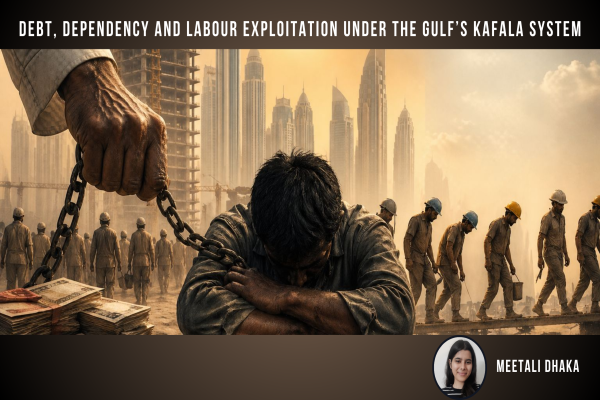
April 27, 2026 Meetali Dhaka
Abstract
Millions of workers from South Asia and Africa migrate to the Gulf Cooperation Council (GCC) countries every year and sustain their construction, service and domestic labour economies. Despite their economic contribution, they undergo inhumane labour exploitation and human rights violations under the Kafala system, the legal framework that ties them to their employers for their residence, employability and survival. Drawing on reports from Human Rights Watch, Migrant-Rights.Org, media investigations, documentaries and Benyamin’s Goat Days, this paper examines how wage theft, legal exclusion, restricted mobility and poor working conditions operate as mechanisms of labour control in the Gulf. The paper argues that while several GCC states have devised labour reforms, they remain fragmented and weakly enforced and have failed to resolve the structural dependency on the Kafala system. Further, it explores policy measures that the GCC states and host states could adopt to promote safer and just labour migration.
Keywords: Kafala system, GCC, migrant workers, structural violence, human rights, slavery
Introduction
Between 2012 and mid-2018, more than 10 Indian workers died every day in the Gulf. This is the tragedy faced by numerous migrant workers who have left their homes and families in hopes of a better future. The GCC states have historically remained a major destination for migrant workers in construction, hospitality and service sectors. Millions of workers from India, Nepal, Pakistan, the Philippines, Kenya and many more countries travel annually to Saudi Arabia, Oman, Qatar, Kuwait and the United Arab Emirates. These migrant workers constitute the major portion of the Gulf population. For instance, migrant workers constitute 95 per cent of Qatar’s total labour force, mainly employed in the construction and service sectors. They contribute significantly to the economies of these countries as well as their home countries in the form of remittances (Human Rights Watch, 2020; Nayak, n.d.).
However, behind the public veil of economic mobility lie persistent patterns of labour exploitation. At the centre of this global labour migration lies the kafala system, a legal sponsorship framework that allows the local employers (kafeel) to govern the lives, mobility and employment cycle of migrant workers. These workers are victims of harmful practices by employers and agents such as passport confiscation, wage theft, debt bondage, physical, mental and sexual abuse, long working hours, pathetic working and living conditions, insufficient food and shelter, discrimination, humiliation, and unlawful huge recruitment fees, which leave them vulnerable in the vicious cycle of indebtedness and exploitation (Human Rights Watch, 2020).
Therefore, this paper explores the multiple dimensions of labour abuses faced by subaltern migrant workers under the kafala system, interrogates the key reforms initiated by these states and their limitations. It concludes with policy-oriented recommendations for both the host and home countries to improve labour protections and governance of global labour migration.
The Kafala System: Structure and Functioning
In the Shari’a Islamic Law, ‘Kafala’ means guardianship or sponsorship. Historically, it has been used as an instrument of hospitality to protect strangers in the Arabian Peninsula. It later evolved to manage the indentured labour of Kuwait’s pearl diving sector up to the 1950s. Post the 1950s, the British deployed it to regulate the migration flows. Nevertheless, the Oil Boom of the 1970s and early 2000s resulted in unprecedented economic growth and expanded demand for foreign labour to fill the local labour shortages in the oil, energy, construction and domestic workers industries. This transformed the Kafala primarily into a state-controlled tool to recruit and regulate foreign labour (Kanchana, 2018).
Under this legal framework, migrant workers need a local sponsor (kafeel), who could either be an individual or a company, to enter the country, obtain a work permit, maintain a legal residency, and exit the country. Moreover, the workers cannot even get their visas renewed or change employment without seeking the kafeel’s permission. This underlines the power imbalance in this particular employer-employee relationship, where the former has power over the lives of workers beyond the workplace. This places the migrant workers in a position of extreme dependency and vulnerability (Kanchana, 2018).
Multiple Dimensions of Labour Exploitation under the Kafala System
1. Exclusion from Law and Legal Protection
Every state has a Ministry of Labour that grants legal protection and safeguards the labour rights of workers. However, in the GCC countries, it is the Ministry of Interior instead of the Ministry of Labour that deals with issues of migrant workers, which leads to their exclusion from the host countries’ labour laws and legal protections. This denies them their fundamental rights and exacerbates their vulnerabilities to exploitation by their sponsor or employer (not necessarily the same person), underlining abusive power hierarchies (Ashok, 2024).
2. Debt Bondage through Recruitment Fee
Qatar Companies outsource their recruitment fee payment to contractors and subcontractors to increase their competitive advantage. These recruitment agents charge huge recruitment fees from workers in their home country. Due to immense poverty, these workers often take hefty loans from banks and relatives and are already in debt even before they migrate to the GCC countries. The moneylenders create issues for their families in their homeland. For instance, 72 migrant workers from Kenya, India, Nepal and other countries interviewed by the Human Rights Watch paid between $693 and $2,613 in recruitment fees to secure jobs in Qatar. Similarly, Najeeb Muhammad, a Kerala migrant worker in Saudi Arabia in Benyamin’s Goat Days, also had to borrow money from his relatives and sell his wife’s jewellery to arrange this fee (Benyamin, 2012; Human Rights Watch, 2020).
3. Wage Theft and Income Insecurity
Wage Theft is one of the biggest issues faced by migrant workers in the GCC countries. There are countless cases of delayed or non-payment of wages to migrant workers. More than 3740 migrants in Saudi Arabia filed complaints against nonpayment of wages and refusal to renew residency permits in 2014. Likewise, Najeeb in Goat Days worked for almost three years without receiving a penny in return as a shepherd in the Arabian desert. (Benyamin, 2012; Human Rights Watch, 2020; Migrant-Rights.Org, nd.)
Furthermore, there are cases of wage deduction in the first month of the job in disguise as a “security deposit”, which comes under the ILO’s indicators of forced labour. There is often no payment if there are no clients, a practice called ‘warehousing.’ This, however, is a problematic term since it blames the poor migrant worker. This affects workers’ ability to repay loans and further pushes them into debt bondage as they keep working without payments in the hope of receiving money in future. The sad irony is that the workers are lured with promises of better economic mobility while they end up in more debt (Human Rights Watch, 2020; MacInnes, 2024; The Guardian, 2014).
4. Contract Substitution: Fake Dreams, Real Torture
Recruiting agents sell fake dreams of higher salaries and better opportunities for economic upliftment to poor migrant workers in their home country. A well-detailed contract mentioning wage, leaves, and other benefits is signed by a worker before migrating. However, these contracts are often torn off or snatched in flight or after they reach the host country. They are then forced to accept substituted contracts which don’t match the original ones. This fraudulent practice of contract substitution pushes the workers into forced labour (Human Rights Watch, 2020).
5. Passport Confiscation: GCC’s Caged Workforce
Passport Confiscation is one of the significant employment exploitation practices against migrant workers in the GCC countries. As soon as they reach the host country, their sponsors or employers snatch their passports at the airport, arguing this ensures that they will not run away from work. This restricts the workers’ mobility and labels them as ‘illegal’ because they no longer possess their valid documents, which include passports and other documents as well. As per the interviews conducted by Migrant-Rights.Org, 90% of the 1000+ low-income migrant workers interviewed in Qatar did not possess their passports. More than 8000 complaints were filed against delayed wages and passport confiscation in Kuwait’s labour disputes offices in 2014 (Human Rights Watch, 2024; Migrant-Rights.org, n.d)
.
6. Inhumane Working and Living Conditions: Dehumanisation of Migrant Workers
Migrant workers in the GCC suffer from hazardous working conditions and inhumane living conditions. Workers engaged in the construction industry work in desert areas with no shade. They face scorching heat, inadequate rest, and risky work tasks that cost them lifelong respiratory diseases, loss of limbs, and even death. The number of Indian migrants dying in Oman almost doubled from 495 deaths in 2017 to 913 deaths in 2021. Additionally, over 900 Indians, mostly from Kerala, have gone missing over the last 15 years in the GCC countries (Human Rights Watch, 2024; Mirrors.Org, 2015; Yadav, 2022).
They live in overcrowded places with improper sanitation and hygiene. They use salty water to take a bath, and that too in the restroom, since they don’t have separate bathrooms. The food is insufficient, and their kitchens are extremely unhealthy. In case of medical injury, they were not provided any healthcare assistance or compensation. This is a strict violation of these workers' labour and human rights (Human Rights Watch, 2024; The Guardian, 2014; The Guardian, 2015; The New York Times, 2023).
Reforms in the Kafala or Hollow Promises?
Qatar installed a Wage Protection System (WPS) in 2015, following the United Arab Emirates’ lead in 2009. All GCC countries have their different versions working. Nonetheless, this system is merely a wage monitoring system that suffers from a weak alert system and leaves 7 lakh workers uncovered. Additionally, in 2018, the Labour Dispute Resolution Committees were established, which also proved ineffective due to staff shortage, travel costs, embassies’ limited assistance, employers’ lack of participation, false accusations of “absconding,” fear of being deported, and absence of documents as evidence. Workers who abscond are considered illegal and face detention. Workers reported that this is a “Catch-22” situation for them - indebted if they complain, indebted if they don’t (Human Rights Watch, 2020).
In 2016, Saudi Arabia announced reforms enabling workers to change jobs without employers’ permission if the employer fails to renew the worker’s residence permit and does not pay their wages for three consecutive months. In 2017, the UAE announced similar reforms. However, the UAE government rarely investigates cases of passport confiscation, delayed or nonpayment of wages, and contract substitutions. Kuwait, Oman and Bahrain have not introduced any major reforms but followed a couple of similar reforms, which also haven’t been effective (“Reform the Kafala, n.d; Qadri, 2020)
Lastly, Saudi Arabia has taken one step further by officially announcing to replace the Kafala system in June 2025 with a more flexible contractual employment system that will also allow migrant workers to leave the country without an exit visa and access crucial legal protections that were previously unavailable. Although the Kafala System was formally replaced by a contractual model via the Qiwa platform by late 2025, Human Rights Watch’s World Report 2026 and activist analyses note that enforcement gaps remain, with persistent wage theft and limited remedies for many workers. Therefore, the wider motive to dismantle the system has been largely missing in various fragmented reforms introduced by the GCC countries (Human Rights Watch, 2026; TOI World Desk, 2025).
Policy Recommendations
Provided the inherent structural violence of the Kafala System, the GCC countries must take strict and urgent reforms to delink the strict overdependence of migrant workers on their kafeel. The Wage Protection System must be strengthened, where employers must be obliged to give physical pay slips to employees and give a detailed description of the contract, wages and leaves. National governments from both home and host countries should work together to track the passage of migrant workers’ trafficking and avoid contract substitution. National government agents must be engaged in contract signing instead of corrupt private recruiting agents. The legal institution must be easily accessible with lower costs, and employers must be obliged to participate in the process.
The GCC governments should decriminalise the “absconding” act since it is often misused by employers against migrant workers who try to escape their abuse. More staff should be employed in both host countries’ institutions and home countries’ embassies. A special police force can be trained to monitor and stop the abuse and exploitation of these workers. Lastly, migrant workers should also be covered by national legal laws. Nonetheless, the excessive economic advantage to the Gulf employers and states and the political monarchy of the GCC countries are some significant challenges in front of these reforms.
Conclusion
The Kafala system is a legal framework to recruit foreign workers into the GCC countries, where a worker’s fate is in the hands of their employer. Through debt bondage, passport confiscation, systematic wage theft and abuse, it inculcates a power hierarchy and a global chain of labour abuse. The reforms taken by the GCC countries are hollow promises that fail to dismantle the architecture of inherent violence in the kafala system. The story of Najeeb Muhammad from India is only one among the millions whose lives are marked by extreme hardship. The fake promises of economic mobility translate into restricted physical mobility, debt bondage and detention. Abolishing the Kafala system demands more than mere policy tweaks; it demands changes at the structural operation of the system and involvement of host and home countries and international communities.
References
Millions of workers from South Asia and Africa migrate to the Gulf Cooperation Council (GCC) countries every year and sustain their construction, service and domestic labour economies. Despite their economic contribution, they undergo inhumane labour exploitation and human rights violations under the Kafala system, the legal framework that ties them to their employers for their residence, employability and survival. Drawing on reports from Human Rights Watch, Migrant-Rights.Org, media investigations, documentaries and Benyamin’s Goat Days, this paper examines how wage theft, legal exclusion, restricted mobility and poor working conditions operate as mechanisms of labour control in the Gulf. The paper argues that while several GCC states have devised labour reforms, they remain fragmented and weakly enforced and have failed to resolve the structural dependency on the Kafala system. Further, it explores policy measures that the GCC states and host states could adopt to promote safer and just labour migration.
Keywords: Kafala system, GCC, migrant workers, structural violence, human rights, slavery
Introduction
Between 2012 and mid-2018, more than 10 Indian workers died every day in the Gulf. This is the tragedy faced by numerous migrant workers who have left their homes and families in hopes of a better future. The GCC states have historically remained a major destination for migrant workers in construction, hospitality and service sectors. Millions of workers from India, Nepal, Pakistan, the Philippines, Kenya and many more countries travel annually to Saudi Arabia, Oman, Qatar, Kuwait and the United Arab Emirates. These migrant workers constitute the major portion of the Gulf population. For instance, migrant workers constitute 95 per cent of Qatar’s total labour force, mainly employed in the construction and service sectors. They contribute significantly to the economies of these countries as well as their home countries in the form of remittances (Human Rights Watch, 2020; Nayak, n.d.).
However, behind the public veil of economic mobility lie persistent patterns of labour exploitation. At the centre of this global labour migration lies the kafala system, a legal sponsorship framework that allows the local employers (kafeel) to govern the lives, mobility and employment cycle of migrant workers. These workers are victims of harmful practices by employers and agents such as passport confiscation, wage theft, debt bondage, physical, mental and sexual abuse, long working hours, pathetic working and living conditions, insufficient food and shelter, discrimination, humiliation, and unlawful huge recruitment fees, which leave them vulnerable in the vicious cycle of indebtedness and exploitation (Human Rights Watch, 2020).
Therefore, this paper explores the multiple dimensions of labour abuses faced by subaltern migrant workers under the kafala system, interrogates the key reforms initiated by these states and their limitations. It concludes with policy-oriented recommendations for both the host and home countries to improve labour protections and governance of global labour migration.
The Kafala System: Structure and Functioning
In the Shari’a Islamic Law, ‘Kafala’ means guardianship or sponsorship. Historically, it has been used as an instrument of hospitality to protect strangers in the Arabian Peninsula. It later evolved to manage the indentured labour of Kuwait’s pearl diving sector up to the 1950s. Post the 1950s, the British deployed it to regulate the migration flows. Nevertheless, the Oil Boom of the 1970s and early 2000s resulted in unprecedented economic growth and expanded demand for foreign labour to fill the local labour shortages in the oil, energy, construction and domestic workers industries. This transformed the Kafala primarily into a state-controlled tool to recruit and regulate foreign labour (Kanchana, 2018).
Under this legal framework, migrant workers need a local sponsor (kafeel), who could either be an individual or a company, to enter the country, obtain a work permit, maintain a legal residency, and exit the country. Moreover, the workers cannot even get their visas renewed or change employment without seeking the kafeel’s permission. This underlines the power imbalance in this particular employer-employee relationship, where the former has power over the lives of workers beyond the workplace. This places the migrant workers in a position of extreme dependency and vulnerability (Kanchana, 2018).
Multiple Dimensions of Labour Exploitation under the Kafala System
1. Exclusion from Law and Legal Protection
Every state has a Ministry of Labour that grants legal protection and safeguards the labour rights of workers. However, in the GCC countries, it is the Ministry of Interior instead of the Ministry of Labour that deals with issues of migrant workers, which leads to their exclusion from the host countries’ labour laws and legal protections. This denies them their fundamental rights and exacerbates their vulnerabilities to exploitation by their sponsor or employer (not necessarily the same person), underlining abusive power hierarchies (Ashok, 2024).
2. Debt Bondage through Recruitment Fee
Qatar Companies outsource their recruitment fee payment to contractors and subcontractors to increase their competitive advantage. These recruitment agents charge huge recruitment fees from workers in their home country. Due to immense poverty, these workers often take hefty loans from banks and relatives and are already in debt even before they migrate to the GCC countries. The moneylenders create issues for their families in their homeland. For instance, 72 migrant workers from Kenya, India, Nepal and other countries interviewed by the Human Rights Watch paid between $693 and $2,613 in recruitment fees to secure jobs in Qatar. Similarly, Najeeb Muhammad, a Kerala migrant worker in Saudi Arabia in Benyamin’s Goat Days, also had to borrow money from his relatives and sell his wife’s jewellery to arrange this fee (Benyamin, 2012; Human Rights Watch, 2020).
3. Wage Theft and Income Insecurity
Wage Theft is one of the biggest issues faced by migrant workers in the GCC countries. There are countless cases of delayed or non-payment of wages to migrant workers. More than 3740 migrants in Saudi Arabia filed complaints against nonpayment of wages and refusal to renew residency permits in 2014. Likewise, Najeeb in Goat Days worked for almost three years without receiving a penny in return as a shepherd in the Arabian desert. (Benyamin, 2012; Human Rights Watch, 2020; Migrant-Rights.Org, nd.)
Furthermore, there are cases of wage deduction in the first month of the job in disguise as a “security deposit”, which comes under the ILO’s indicators of forced labour. There is often no payment if there are no clients, a practice called ‘warehousing.’ This, however, is a problematic term since it blames the poor migrant worker. This affects workers’ ability to repay loans and further pushes them into debt bondage as they keep working without payments in the hope of receiving money in future. The sad irony is that the workers are lured with promises of better economic mobility while they end up in more debt (Human Rights Watch, 2020; MacInnes, 2024; The Guardian, 2014).
4. Contract Substitution: Fake Dreams, Real Torture
Recruiting agents sell fake dreams of higher salaries and better opportunities for economic upliftment to poor migrant workers in their home country. A well-detailed contract mentioning wage, leaves, and other benefits is signed by a worker before migrating. However, these contracts are often torn off or snatched in flight or after they reach the host country. They are then forced to accept substituted contracts which don’t match the original ones. This fraudulent practice of contract substitution pushes the workers into forced labour (Human Rights Watch, 2020).
5. Passport Confiscation: GCC’s Caged Workforce
Passport Confiscation is one of the significant employment exploitation practices against migrant workers in the GCC countries. As soon as they reach the host country, their sponsors or employers snatch their passports at the airport, arguing this ensures that they will not run away from work. This restricts the workers’ mobility and labels them as ‘illegal’ because they no longer possess their valid documents, which include passports and other documents as well. As per the interviews conducted by Migrant-Rights.Org, 90% of the 1000+ low-income migrant workers interviewed in Qatar did not possess their passports. More than 8000 complaints were filed against delayed wages and passport confiscation in Kuwait’s labour disputes offices in 2014 (Human Rights Watch, 2024; Migrant-Rights.org, n.d)
.
6. Inhumane Working and Living Conditions: Dehumanisation of Migrant Workers
Migrant workers in the GCC suffer from hazardous working conditions and inhumane living conditions. Workers engaged in the construction industry work in desert areas with no shade. They face scorching heat, inadequate rest, and risky work tasks that cost them lifelong respiratory diseases, loss of limbs, and even death. The number of Indian migrants dying in Oman almost doubled from 495 deaths in 2017 to 913 deaths in 2021. Additionally, over 900 Indians, mostly from Kerala, have gone missing over the last 15 years in the GCC countries (Human Rights Watch, 2024; Mirrors.Org, 2015; Yadav, 2022).
They live in overcrowded places with improper sanitation and hygiene. They use salty water to take a bath, and that too in the restroom, since they don’t have separate bathrooms. The food is insufficient, and their kitchens are extremely unhealthy. In case of medical injury, they were not provided any healthcare assistance or compensation. This is a strict violation of these workers' labour and human rights (Human Rights Watch, 2024; The Guardian, 2014; The Guardian, 2015; The New York Times, 2023).
Reforms in the Kafala or Hollow Promises?
Qatar installed a Wage Protection System (WPS) in 2015, following the United Arab Emirates’ lead in 2009. All GCC countries have their different versions working. Nonetheless, this system is merely a wage monitoring system that suffers from a weak alert system and leaves 7 lakh workers uncovered. Additionally, in 2018, the Labour Dispute Resolution Committees were established, which also proved ineffective due to staff shortage, travel costs, embassies’ limited assistance, employers’ lack of participation, false accusations of “absconding,” fear of being deported, and absence of documents as evidence. Workers who abscond are considered illegal and face detention. Workers reported that this is a “Catch-22” situation for them - indebted if they complain, indebted if they don’t (Human Rights Watch, 2020).
In 2016, Saudi Arabia announced reforms enabling workers to change jobs without employers’ permission if the employer fails to renew the worker’s residence permit and does not pay their wages for three consecutive months. In 2017, the UAE announced similar reforms. However, the UAE government rarely investigates cases of passport confiscation, delayed or nonpayment of wages, and contract substitutions. Kuwait, Oman and Bahrain have not introduced any major reforms but followed a couple of similar reforms, which also haven’t been effective (“Reform the Kafala, n.d; Qadri, 2020)
Lastly, Saudi Arabia has taken one step further by officially announcing to replace the Kafala system in June 2025 with a more flexible contractual employment system that will also allow migrant workers to leave the country without an exit visa and access crucial legal protections that were previously unavailable. Although the Kafala System was formally replaced by a contractual model via the Qiwa platform by late 2025, Human Rights Watch’s World Report 2026 and activist analyses note that enforcement gaps remain, with persistent wage theft and limited remedies for many workers. Therefore, the wider motive to dismantle the system has been largely missing in various fragmented reforms introduced by the GCC countries (Human Rights Watch, 2026; TOI World Desk, 2025).
Policy Recommendations
Provided the inherent structural violence of the Kafala System, the GCC countries must take strict and urgent reforms to delink the strict overdependence of migrant workers on their kafeel. The Wage Protection System must be strengthened, where employers must be obliged to give physical pay slips to employees and give a detailed description of the contract, wages and leaves. National governments from both home and host countries should work together to track the passage of migrant workers’ trafficking and avoid contract substitution. National government agents must be engaged in contract signing instead of corrupt private recruiting agents. The legal institution must be easily accessible with lower costs, and employers must be obliged to participate in the process.
The GCC governments should decriminalise the “absconding” act since it is often misused by employers against migrant workers who try to escape their abuse. More staff should be employed in both host countries’ institutions and home countries’ embassies. A special police force can be trained to monitor and stop the abuse and exploitation of these workers. Lastly, migrant workers should also be covered by national legal laws. Nonetheless, the excessive economic advantage to the Gulf employers and states and the political monarchy of the GCC countries are some significant challenges in front of these reforms.
Conclusion
The Kafala system is a legal framework to recruit foreign workers into the GCC countries, where a worker’s fate is in the hands of their employer. Through debt bondage, passport confiscation, systematic wage theft and abuse, it inculcates a power hierarchy and a global chain of labour abuse. The reforms taken by the GCC countries are hollow promises that fail to dismantle the architecture of inherent violence in the kafala system. The story of Najeeb Muhammad from India is only one among the millions whose lives are marked by extreme hardship. The fake promises of economic mobility translate into restricted physical mobility, debt bondage and detention. Abolishing the Kafala system demands more than mere policy tweaks; it demands changes at the structural operation of the system and involvement of host and home countries and international communities.
References
- Ashok, M. R. (2024). A Critical evaluation of the ‘Reforms’ in the Kafala System: a case study of Qatar. Electronic Journal of Social & Strategic Studies, 05(03). Retrieved 10 March 2026, from https://doi.org/10.47362/ejsss.2024.5303
- Benyamin. (2012). Goat Days. Penguin UK.
- Human Rights Watch. (2020). “How can we work without wages?” Salary abuses facing migrant workers ahead of Qatar’s FIFA World Cup 2022 [Report]. Retrieved 10 March 2026, from https://www.hrw.org/report/2020/08/24/how-can-we-work-without-wages/salary-abuses-facing-migrant-workers-ahead-qatars
- Human Rights Watch. (2024). “Die first, and I’ll pay you later” Saudi Arabia’s ‘Giga-Projects’ built on widespread labor abuses [Book]. Retrieved 10 March 2026, from https://www.hrw.org/report/2024/12/04/die-first-and-ill-pay-you-later/saudi-arabias-giga-projects-built-widespread
- Human Rights Watch. (2026, February). Saudi Arabia: Events of 2025. Retrieved 10 March 2026, from https://www.hrw.org/world-report/2026/country-chapters/saudi-arabia
- Indians gone missing; Decades of stories from the GCC. (2015, November 16). MRRORS.org. Retrieved 10 March 2026, from https://www.mrrors.org/2015/11/indians-gone-missing-decades-of-stories-from-the-gcc/
- Kanchana, R. (2018). Is the Kafala Tradition to Blame for the Exploitative Work Conditions in the Arab-Gulf Countries?. Retrieved 10 March 2026, from https://papers.ssrn.com/sol3/Delivery.cfm?abstractid=3360976
- MacInnes, P. (2024, November 26). Migrant workers face ‘cycle of abuse’ in Saudi Arabia before World Cup, UN told. The Guardian. Retrieved 10 March 2026, from https://www.theguardian.com/football/2024/nov/26/migrant-workers-saudi-arabia-abuse-world-cup-un
- Migrant Rights Statistics Low Wage Workers. (n.d.). Migrant-Rights.Org. Retrieved 10 March 2026, from https://www.migrant-rights.org/statistic/low-wage-workers/
- Nayak, V. (n.d.). RTI reveal: More than 10 Indian workers died every day in Gulf countries in the last six years; 117 deaths for every US$ 117 remitted. Commonwealth Human Rights Initiative. Retrieved 10 March 2026, from https://www.humanrightsinitiative.org/blog/rti-reveal-more-than-10-indian-workers-died-every-day-in-gulf-countries-in-the-last-six-years-117-deaths-for-every-us-117-remitted-
- QADRI, M. (2020). THE UAE’S KAFALA SYSTEM: HARMLESS OR HUMAN TRAFFICKING? In M. T. PAGE & J. VITTORI (Eds.), DUBAI’S ROLE IN FACILITATING CORRUPTION AND GLOBAL ILLICIT FINANCIAL FLOWS (pp. 79–84). Carnegie Endowment for International Peace. Retrieved 10 March 2026, from http://www.jstor.org/stable/resrep26918.13
- Reform the Kafala System. (n.d.). Migrant-Rights.Org. Retrieved 10 March 2026, from https://www.migrant-rights.org/campaign/end-the-kafala-system/
- The Guardian. (2014). Qatar World Cup 2022: Migrant workers forced to work for no pay [Video]. Youtube. Retrieved 10 March 2026, from https://www.youtube.com/watch?v=e5R9Ur44XV8&list=PLbddLKgV48tJD-m1lHz1LL1_XKEoIIp54&index=14
- The Guardian. (2015). Qatar’s World Cup 2022 workers: “We may as well just die here” | Guardian Investigations [Video]. Youtube. Retrieved 10 March 2026, from https://www.youtube.com/watch?v=I0EsOFDA6uM&list=PLbddLKgV48tJD-m1lHz1LL1_XKEoIIp54&index=14
- The New York Times. (2023). What Happens to the Migrant Workers Who Built the World Cup? | NYT News [Video]. Youtube. Retrieved 10 March 2026, from https://www.youtube.com/watch?v=Cr3d4Oi0Mas&list=PLbddLKgV48tJD-m1lHz1LL1_XKEoIIp54&index=7
- TOI World Desk. (2025, October 23). Saudi Arabia abolished Kafala System after 50 years; grants freedom and new rights to millions of migrant workers. The Times of India. Retrieved 10 March 2026, from https://timesofindia.indiatimes.com/world/middle-east/saudi-arabia-abolishes-kafala-system-after-50-years-grants-freedom-and-new-rights-to-millions-of-migrant-workers/articleshow/124660103.cms
- Yadav, P. (2022, July 25). Explained: Why Are Indian Migrant Workers Dying In The Gulf Countries. India Times. Retrieved 10 March 2026, from https://www.indiatimes.com/explainers/news/why-are-indian-migrant-workers-dying-in-the-gulf-countries-575571.html
About the Author:
Meetali Dhaka holds MA in Global Studies from Dr. B.R. Ambedkar University. She was a former researcher at the Indic Researchers Forum
Note:
The article reflects the opinion of the author and not necessarily the views of the organisation.
Share this article:
© Copyright 2026 Indic Researchers Forum | Designed & Developed By Bigpage.in