
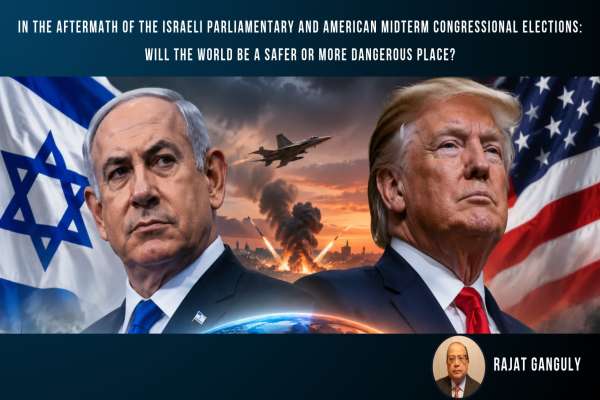
In The Aftermath Of The Israeli Parliamentary And American Midterm Congressional Elections: Will The World Be A Safer Or More Dangerous Place?
November 05, 2026 Rajat Ganguly
Introduction
I see a lot of euphoria, particularly amongst many of my academic colleagues, journalists and experts, that with the electoral setbacks suffered by Israeli PM Benjamin Netanyahu and American President Donald Trump the massive turbulence in international politics unleashed principally by them will now gradually calm down. Optimists argue that if PM Netanyahu loses power or is forced to govern through a difficult coalition, this will put the brakes on his Greater Israel project and help to reduce and eventually end the wars in Gaza, Lebanon, and Iran. Similarly, a badly weakened President Trump, facing budgetary squeeze and greater scrutiny of his administration from a Democratic Party controlled Congress on the back of a hostile public mood, will be forced to distance America from the forever wars in Ukraine and the Middle East and focus more or solving the real problems being faced by the American people. I sincerely hope the optimists will be proved right. But I am not celebrating yet. In fact, I am deeply worried that things may take a turn for the worse over the next few weeks.
Wounded Tigers are Desperate and Dangerous
Both Netanyahu and Trump are like wounded tigers right now. And a tiger is most dangerous when it is wounded! Netanyahu has always had one main mission: to destroy Iran and the military threat posed by the Islamist regime to Israel, both directly through its weapons and missiles programs and indirectly through armed non-state proxies such as the Hezbollah, Hamas, and the Houthis. Since the October 7 attacks on Israel by Hamas, he has steadfastly made it his mission to destroy Hamas, Hezbollah and the Iranian state/regime itself. In the process, he and his government have committed acts of genocide and war crimes. He is also facing significant corruption charges, which may come back to haunt him if he loses power. In words, Netanyahu may be wounded and desperate right now. And a wounded and desperate leader may be open to a ‘all or nothing’ gamble.
Trump is in a similar situation. As a personality, he is an egotist, a narcissist, a liar, and purely interested in his own and his family's financial and business wellbeing. He ran his business empire like a mafia boss, a style he then brought with him to the White House. He had promised that he would end the forever wars that the neocons had got America involved in since the end of the Cold War. But not only did he not do anything of substance to end the war in Ukraine, he has given in to Netanyahu's pressure and launched the illogical war against Iran. He is now likely to face a hostile Democratic Party-controlled Congress, which can squeeze his administration financially and open investigations into his and some of his cabinet colleagues' senior officials' conduct. In other words, Trump like Netanyahu is badly wounded and desperate now. And a wounded and desperate leader is highly unpredictable.
The Question of Pre-emptive Tactical Nuclear Strikes on Iran
Could Netanyahu and Trump do something highly dangerous to save themselves politically and satisfy their egos, and present the world with a fait accompli? I am deeply worried by the ‘chatter’ in some circles that Israel, with permission and support from the United States, could carry out tactical nuclear strikes on Iran in an effort to destroy the 450 kilos of 60% enriched Uranium stockpile that Tehran has buried deep underground and which could upon further enrichment produce ten to twelve nuclear warheads.
The answer to this question, in my opinion, is not strictly speculative and theoretical. Israel has between 80-100 nuclear warheads of various payloads, including tactical nuclear weapons. These nuclear weapons, particularly if used pre-emptively, are Israel’s ultimate guarantee against complete strategic defeat at the hands of powerful external enemies like Iran. Israel is a small state lacking strategic depth with a population that is roughly one-ninth the size of the population of Iran. If Iran retains its stockpile of enriched Uranium and restarts its enrichment program, it could very quickly develop its own nuclear warheads. Fitted to Iran’s stockpile of missiles, particularly hypersonic missiles, these ten to twelve nuclear warheads will pose an existential threat to the Jewish state. It has been reported that Israeli intelligence believes that the first two rounds of Israeli/American attack on Iran has not destroyed its Uranium stockpile. It has also been reported in some quarters that Iran’s nuclear scientists have rebuilt and repaired its enrichment facilities and restarted the Uranium enrichment program. Moreover, this time around, key regime leaders have been reported to be in favour of weaponising Iran’s nuclear capabilities and revising Iran’s nuclear posture.
If this Israeli assessment is accurate or at least if the Israelis believe it to be accurate, then a politically wounded and desperate Netanyahu could launch a pre-emptive nuclear strike on Iran in the hope of presenting the Israeli public and the world at large with three possible scenarios/outcomes: (a) The nuclear strikes will force the Iranian leadership and the IRGC into a complete and unconditional surrender, which will bring the war to an end. (b) The nuclear strikes will trigger regime change in Iran along with the disintegration of the IRGC. (c) The nuclear strikes will destroy Iran’s nuclear stockpile and enrichment facilities buried deep underground and thus ensure that Iran will never be able to develop nuclear warheads that could threaten Israel’s existence.
If Netanyahu chooses to go nuclear, Israel will use tactical nukes on specific targets such as nuclear reactors and research installations, IRGC command and control centres, missile and drone manufacturing factories and storage facilities, and critical infrastructure. The aim will be to rapidly degrade the Iranian military and IRGC, destroy Iran’s military-industrial complexes and nuclear research facilities, and force the surviving political and military leadership into a complete and unconditional surrender. This will then set the stage for regime change. American and Israeli boots could be placed on the ground at that stage as they are not likely to meet much resistance to facilitate and bed-in the new regime.
Would Trump likely to go along with Netanyahu and support Israeli nuclear strikes on Iran? He might for the following reasons. First, he has publicly stated that he will not allow Iran to develop nuclear weapons. If Netanyahu convinces him that this is exactly what Iran is doing and that waiting would put the Jewish state and American/Israeli allies in the region at grave existential risk, Trump may be willing to support pre-emptive Israeli nuclear strikes on Iran. Second, after the humiliation of the midterm elections, a wounded and hurting Trump may be tempted by the possibility of ‘spectacular success’ in destroying Iran, the Islamic regime, and the state’s nuclear weapons program. He may calculate that this kind of spectacular success will strengthen his political position vis-à-vis his domestic opponents for the remainder of his presidency and consolidate his position in American presidential history. Third, there are rumours that Netanyahu and the Israeli intelligence community have certain incriminating materials on Trump (the Epstein files for example) with which they could pressurise the president into supporting Israeli policy of nuking Iran. Trump’s key political donors (many of whom are from the influential Israeli lobby in Washington) may also bring pressure on him and his cabinet to support Israel’s decision to launch a pre-emptive nuclear strike on Iran. Finally, America has suffered massive military damage in the war with Iran. The IRGC’s attacks on American military bases in the region, and on American warships, aircraft, radars, military equipment, storage facilities and personnel deployed in West Asia and the Persian Gulf have been intense and devastating. This has caused serious damage to American military and economic assets as well as political standing in the region. The massive economic, financial, strategic, and reputational damage to the United States has brought incredible pressure on the Trump administration to retreat from the region with its tail between its legs. Trump, therefore, may regard an Israeli pre-emptive nuclear strike on Iran as not only retribution but also forcing the destruction and abject surrender of Iran, which will help consolidate Zionist/American domination of the region for years to come.
Would a Pre-Emptive Nuclear Strike Deliver the Results that Israel and the US May Hope to Achieve?
If my assessment about America and Israel’s intentions and war objectives is correct, it raises two important questions. First, does Iran possess enough fissile materials, enrichment facilities, and technical experts to manufacture nuclear weapons and does the Iranian regime intend to weaponise and use Iran’s nuclear capability? Second, can a pre-emptive nuclear strike destroy Iran’s stockpile of fissile materials and enrichment facilities?
It has been reported that Iran possesses around 450 kilos of 60% enriched uranium. Iranian Foreign Minister, Abbas Araghchi, in recent interviews acknowledged that Iran has this material. According to some experts, if this amount of uranium is enriched up to and beyond 90%, it may be enough to produce ten to twelve nuclear warheads. But where is this enriched uranium located? The consensus view amongst Israeli and American experts and intelligence agencies is that this material is stored inside a tunnel complex buried 100 metres deep under the hard granite rocks of the Pickaxe Mountain or Kuh-e Kolang Gaz La, located about one mile south of the town of Natanz in central Iran. At this depth, the enriched uranium is beyond the reach of American and Israeli conventional bunker buster bombs. Can Iran further enrich this uranium to weapons grade needed to manufacture nuclear warheads? During the American/Israeli bombing campaign in June 2025 and again after February 2026, US and Israeli air force dropped a massive payload of conventional bombs and warheads on Iran’s three main nuclear research centres: Fordow, Natanz and Isfahan. President Trump and Prime Minister Netanyahu claimed that these attacks have dealt a crippling blow to Iran’s capability to produce nuclear weapons. Iranian media also reported that the Fordow, Natanz and Isfahan centres have suffered significant damage, which has degraded Iran’s capability to enrich Uranium stockpiles to weapons grade. Finally, what about the intention to weaponise? Iran’s supreme leader Ayatollah Ali Khamenei used to regard nuclear weapons as un-Islamic; hence, he remained strictly opposed to the development of nukes until his death during the first wave of decapitation airstrikes by the United States and Israel on 28 February 2026. Now that Iran is facing its gravest existential crisis, could it rush the development of a nuclear deterrent that could be used to bargain an end to the American/Israeli attacks, or could be used against Israel and America in the event of a complete strategic defeat? For this to happen, Iran would have to find a way to further enrich the uranium stockpile it has in the middle of a major war and for its new supreme leader, Ayatollah Mujtaba Khamenei, to give the order to weaponize. Both are unknowns at this point although senior Iranian leaders’ recent statements hint that if the Americans and Israelis re-start the war, Iran may consider revising its nuclear weapons policy and posture. If Iran were to cross the threshold, will it be tempted to use its nuclear warheads pre-emptively? The only scenarios where I feel Iran would consider using nukes would be if Israel/America have already used tactical nukes against Iran and/or the Iranian state is on the verge of disintegration and destruction.
There are grave doubts if a pre-emptive Israeli/US tactical nuclear strike on Iran will destroy the 450 kilos of enriched Uranium that Iran possess. First, assuming that the Uranium stockpile is still under the Pickaxe mountain in tunnels at depths of 100 metres or more, the technical difficulty of converting tactical nuclear warheads to ground penetrating munitions would be considerable. Even if these challenges could be overcome, it is very doubtful if the small payload of tactical nukes could penetrate through hard granite and collapse tunnels at depths of over one hundred metres. Second, it is most likely that Iran has scattered the storage of this stockpile to multiple hidden locations. Even if US and Israeli intelligence agencies know the exact locations of this material (which is doubtful), it would require pre-emptive nuke attacks on all these locations. The radiation poisoning and contamination will be substantial, leading to widespread destruction and high civilian fatalities on the ground. And depending on wind flows some of that radiation poisoning will affect population areas even beyond the immediate blast zones. How many civilians would die and what long-term health risks the Iranian people will face is hard to quantify. Most likely, thousands would perish and many times more that number may face significant long-term health risks.
A pre-emptive Israeli/US tactical nuke attack on Iran will bring swift and massive retaliation on Israel, the Gulf states, and the United States itself. Iranian leaders have publicly declared that a nuke attack will be considered as a massive escalation and an immediate existential threat to the Iranian state itself. Iran’s retaliation will be swift, massive and unlimited in scope, both horizontally and vertically. This means at the very least that Iran will hit both civilian, commercial and military targets in Israel and the Gulf states that are allies of Israel and the United States. It will target American military, civilian and commercial targets in the region, including those located in major cities and urban centres. Even Europe (NATO states) and America itself may not be out of reach of Iranian missiles. If Iran has crossed the Rubicon and developed nuclear warheads, it may choose to use these to hit targets in Israel and elsewhere. If Iranian hypersonic missiles with nuclear warheads hit Israel, the consequence will be catastrophic. Hundreds of thousands would perish and millions more would face an extremely bleak future. Vast areas of Israel will face a nuclear winter for the next hundred years, which may lead to the complete ruination of the Jewish state. West-to-east wind flows will carry the radioactive ash from the blast in Israel to neighbouring states like Saudi Arabia, Jordan, Syria, Iraq and even states in the Persian Gulf. People living in these states will also suffer from radioactive poisoning and face a bleak future. In other words, this will be an uncontrollable escalation ladder without any off ramps.
A pre-emptive nuclear strike is likely to harden Iranian people’s attitude towards Israel and the United States and their allies in the region. Iran will therefore come at Israel, the United States and the regional allies with everything they have left. Tehran will certainly activate its proxies and sleeper cells in Israel, the United States, West Asia and Europe. The nuke strikes against Iran will further bring the entire Muslim world together, and there will be mass support for terror attacks against Israel, America and Europe. Large-scale terrorist strikes against the United States, Israel, and European states are likely to happen, leading to domestic political instability in these countries and widespread violence and loss of lives.
Any Israeli/American nuclear strikes against Iran will certainly harden the stance of Arab governments in West Asia, North Africa and the Persian Gulf. It has been reported recently that several Gulf states that were attacked by the IRGC during this war have urged the American government to continue its attacks on the Islamist regime in Iran. These Arab governments are currently upset with the Iranian regime for targeting their countries. However, if nukes are used against Iran and Muslim opinion in the Gulf and worldwide becomes outraged, it will not be long before these Arab states withdraw their support for the war. Saudi Arabia, Jordan, Qatar, Bahrain, Oman, Kuwait and the United Arab Emirates may then demand that the United States close its military bases and withdraw from the region. If this were to happen, it will make Israel feel incredibly vulnerable in terms of its national security. Israel’s ties with Arab neighbours will deteriorate as the Abraham accords will be thrown out. Powerful Arab states such as Saudi Arabia, Qatar, UAE and Egypt along with Türkiye may even come together, with support from non-state actors such as the Hamas, Hezbollah, and the Houthis, to launch major attacks against a weakened Israel.
Internationally, the reaction to the nuking of Iran will be ballistic. Israel and America will be widely condemned, and Netanyahu and Trump will be considered as war criminals by the entire world. Even Israel and America’s staunchest allies in Europe and Asia will find it hard to defend the decision to nuke Iran. Russia and China’s reaction will be much more severe. Moscow may threaten nuclear retaliation against Israel, America, Europe and Ukraine. China may use the opportunity to invade and occupy Taiwan. Beijing and Moscow are certain to get together with the Arab states and demand complete American withdrawal from the West Asia. If the Arab states and Türkiye launch a joint invasion of Israel, Russia and China are most likely to support the invasion. The entire West Asian and Persian Gulf regions along with East Asia could be up in flames quickly.
Nuking Iran will also effectively finish off the Nuclear Non-proliferation Treaty (NPT). For almost six decades, the NPT has been the cornerstone of global non-proliferation efforts. While the treaty is not perfect, it has kept the number of states possessing nuclear weapons to nine (the US, UK, France, China and Russia are allowed to have nuclear weapons; North Korea withdrew from the NPT to develop nukes; and India, Pakistan and Israel are non-signatories to the NPT). This has allowed the international community, according to non-proliferation advocates, to deal effectively with the danger of unchecked nuclear weapons proliferation. This is what risks being unravelled if Iran is nuked by Israel and/or the United States. States with nuclear weapons ambition will make a simple calculation: that Iran’s failure to acquire a credible nuclear deterrent is what allowed Israel and America to launch this war with impunity; by contrast, America has not dared to launch a similar kind of attack on North Korea because of the fear that an all-out attack may induce Pyongyang to launch nuclear weapons at South Korea, Japan and the United States itself. This simple message will now resonate with several states that once had a nuclear weapons development program but later gave it up (Brazil, Argentina, South Africa) as well as states with known nuclear weapons ambition (Saudi Arabia, Türkiye). States like Japan, South Korea and Australia may also feel compelled to think about developing their own nuclear deterrence. In other words, the proliferation of nuclear weapons beyond the current nine will become a real possibility. This may have serious a destabilizing effect on the entire international system.
An Israeli/American pre-emptive tactical nuke attack will be in flagrant violation of international norms and international law. The international system is based on the fundamental norm of ‘state sovereignty’ and its two entailments: ‘non-intervention’ and ‘non-use of force’. If states are to be sovereign, then other states must not intervene in the affairs of a sovereign state; other states must also not use force or threaten to use force against a sovereign state. The only exception to this norm is the right of self-defence. As the United Nations (UN) Charter under Article 51 makes clear, states may use force individually or collectively against another state but only in self-defence and only after an armed attack has taken place. Moreover, the self-defence response must be proportional to the original violation. In this regard, any use of nuclear weapons (tactical or strategic) will be considered a gross violation of the international taboo against the offensive military use of nuclear weapons. It would also be in flagrant violation of Iran’s sovereignty, if the attack happens pre-emptively without a shred of evidence that Iran is developing nuclear weapons and intends to use these weapons against Israel and the United States.
Finally, pre-emptive tactical nuclear strikes on Iran will collapse the global economy. Energy and food shortages across the world will lead to hunger strikes, riots and violent civil wars. Disruption of international transportation will destroy supply chains and lead to serious economic downturns and worldwide depression. If the nuclear strikes lead to uncontrolled horizontal and vertical escalation and sucks in other nuclear powers, it may lead to a catastrophic third World War and the end of humanity.
Conclusion
The recently concluded Israeli parliamentary and American midterm Congressional elections offer a glimmer of hope that the Iran war could gradually wind down through a negotiated agreement between Tehran and Washington DC/Tel Aviv. If this were to happen, together with a simultaneous winding down of the Ukraine war, the recent turbulence in world politics will calm down considerably. However, to facilitate this process, pressure must be brought on Israel and the United States not to initiate new attacks (including tactical nuke attacks) on Iran. In my judgement, this pressure must be brought by three categories of actors.
First, the Gulf states (UAE, Oman, Qatar, Kuwait, Bahrain) and other powerful Muslim states (Saudi Arabia, Türkiye, Egypt, Pakistan, Iraq, Syria) must threaten to sever their ties with Israel and the United States in the event of another Israeli/US strike on Iran, with or without tactical nuclear weapons. If this were to happen, Israel will find itself as a pariah state in the region immediately with severe national security consequences. The United States will be kicked out of the region with American military bases destroyed, political support dwindling, and commercial interests severely hit. Consequently, there will be a net decline in US power in the region, a void likely to be filled by Russia and China.
Second, the entire BRICS must stand with Iran against Israeli/American aggression. The BRICS must insist on an immediate ceasefire and mediated negotiations to bring this war to an end. Apart from Russia and China, the stance of one specific BRICS member will be crucial in this calculus: India. Under Prime Minister Modi, India has aggressively followed a policy of multi-alignment and strategic autonomy. In practice, multi-alignment has meant that India is open to business with all without much care about existing alliances and friendships/enmities. So, India can be friends and business partners with Israel and Iran or with the United States and Russia simultaneously, without letting the nature of the relationship between actors in each dyad to adversely affect their ties with India. Some might call it a classic hedging strategy by India. Others may see India as purely transactional. I tend to regard this as India’s aggressive implementation of the concept of strategic autonomy, which has been a bedrock of Indian foreign policy for the past eight decades. But this stance is now beginning to create problems for India within the BRICS, particularly in the context of the Iran war. If the Modi government accepts the premise that this war must end now, it then needs to open its mouth and say it. The Indian government’s initial silence after the war started and Ayatollah Khamenei was assassinated has not gone down well with other BRICS members and within the Global South community. Given Modi’s stature in international relations and his personal ties with both Trump and Netanyahu on one hand and Pezeshkian and Araghchi on the other, his active moves (if he makes them) to bring this war to an immediate end may prove effective. But to do that, India can no longer sit on the fence. It needs to take a stance, along with other BRICS members, on the side of international norms and international law.
Finally, the role of European powers and the European Union will be important if this war must end immediately. Spain took a principled stand on the US/Israeli attack on Iran even though it invited the enmity of the US government and President Trump. Britain, France, Germany, Poland, and the European Union must now show courage and emulate Spain. America’s principal non-European allies, particularly South Korea, Taiwan, Japan, Canada and Australia must do so as well. The collective message that America and President Trump must be sent is this: The era of hegemony and naked predatory aggression is now over; You will find yourself isolated and friendless if you choose to walk on this path. If America gets this message, Netanyahu and Israel will, too.
About the Author:
Dr Rajat Ganguly is the Director of the Salil Kumar Ganguly Centre for National Security Studies
Note:
The article reflects the opinion of the author and not necessarily the views of the organisation.
Share this article:
© Copyright 2026 Indic Researchers Forum | Designed & Developed By Bigpage.in