
The Shadow Play of Advisory Rhetoric: USCIRF’s Latest Missive on India and the Imperative of Strategic Clarity
March 17, 2026 Srinivasan Balakrishnan
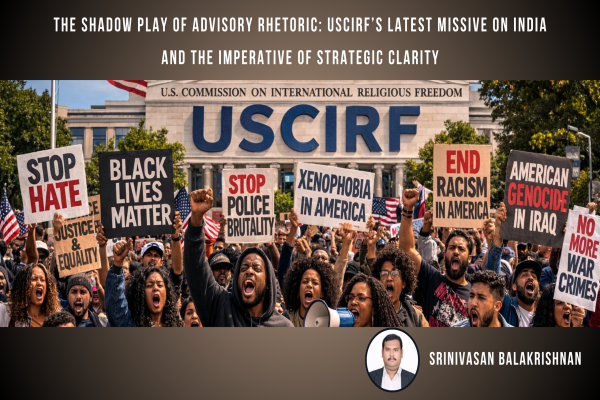
In the realm of international relations, where genuine statecraft intersects with the softer undercurrents of narrative warfare, the United States Commission on International Religious Freedom (USCIRF) has once again issued its annual report, this time, in March 2026, recycling familiar refrains against India. The panel recommends designating India a “Country of Particular Concern,” imposing targeted sanctions on the Rashtriya Swayamsevak Sangh (RSS) and India’s premier external intelligence agency, the Research and Analysis Wing (R&AW), and conditioning arms sales and trade linkages on unspecified “improvements” in religious freedom. It cites anti-conversion laws, alleged vigilante incidents, and legislative measures such as the Waqf Amendment Act as evidence of systemic deterioration.
Yet a dispassionate examination reveals this exercise for what it is: an advisory footnote, devoid of binding force, routinely sidelined by the very government it seeks to influence. Successive U.S. administrations, spanning the Trump and Biden eras, have consistently declined to act on identical USCIRF prescriptions since at least 2020. India has never been formally designated a Country of Particular Concern. No sanctions have materialised. Arms exports and defence cooperation have, in fact, deepened, underscoring the primacy of shared strategic imperatives over ideological checklists. The latest recommendations, like their predecessors, remain destined for the same archival irrelevance: bureaucratic ritual that neither alters policy nor commands diplomatic gravity.
This persistent disconnect invites scrutiny not of India’s vibrant, pluralistic democracy, home to 1.4 billion citizens practising every major faith in harmonious coexistence, but of the ecosystem shaping such reports. India’s External Affairs Ministry has rightly characterised these assessments as “biased” and “politically motivated,” a pattern that aligns with broader concerns over external actors seeking to fracture the Indo-U.S. partnership. Pakistan’s Inter-Services Intelligence (ISI) has long honed the art of hybrid influence operations, leveraging diaspora networks, sympathetic lobbies, and proxy narratives within Western institutions to advance an ideological agenda against India. Elements within the U.S. ecosystem, whether through funding conduits, advocacy groups, or selective amplification, appear susceptible to such infiltration, transforming what should be objective analysis into a vector for narrative subversion. The targeting of the RSS, a grassroots cultural organisation dedicated to national integration, social service, and voluntary discipline, alongside R&AW, India’s bulwark against cross-border terrorism and regional destabilisation, fits neatly into this playbook. It is less about religious freedom and more about undermining institutions central to India’s sovereignty and security posture.
The RSS, far from the caricature occasionally peddled abroad, embodies a philosophy of selfless nation-building that has contributed to disaster relief, education, and community cohesion across India’s diverse landscape. R&AW, meanwhile, stands as a professional intelligence apparatus that has repeatedly neutralised threats originating from Pakistan-based networks, the very source of the malign influence now suspected in Washington’s advisory corridors. To equate these pillars of Indian resilience with violations of international norms is not merely inaccurate; it risks inverting the moral calculus, shielding aggressors while scrutinising the defender.
Compounding this external dynamic is the domestic echo chamber. Certain Indian opposition parties have predictably seized upon the USCIRF report, amplifying its claims with theatrical urgency. In doing so, they inadvertently or perhaps deliberately, position themselves as conduits for foreign-sourced narratives, exposing a willingness to subordinate national interest to partisan theatre. This performative alignment risks portraying them as unwitting participants in a larger ideological campaign aimed at eroding India’s internal cohesion and international stature. True statesmanship demands rejecting such imported discord in favour of constructive engagement with India’s constitutional commitment to secular governance and minority protections, which have endured despite challenges.
For the United States, the lesson is clear: vigilance against adversarial hybrid warfare must extend to its own advisory institutions. Allowing ISI-linked influences to shape discourse on a vital partner like India serves neither American strategic interests nor the cause of genuine religious freedom. The Indo-U.S. relationship, anchored in defence pacts, technology transfers, counter-terrorism cooperation, and shared democratic values represents one of the most consequential partnerships of the 21st century. It cannot be held hostage to recycled advisories that ignore ground realities: India’s robust electoral democracy, independent judiciary, and proactive measures against extremism.
The USCIRF recommendations warrant neither alarm nor accommodation. They are advisory theatre, historically inconsequential and contextually compromised. India’s democratic resilience, buttressed by institutions like the RSS and R&AW, remains unassailable. The onus now lies on Washington to prioritise partnership over posturing, recognising that the true threat to bilateral harmony emanates not from New Delhi, but from the shadows of external malign actors operating within the U.S. ecosystem itself.
Yet a dispassionate examination reveals this exercise for what it is: an advisory footnote, devoid of binding force, routinely sidelined by the very government it seeks to influence. Successive U.S. administrations, spanning the Trump and Biden eras, have consistently declined to act on identical USCIRF prescriptions since at least 2020. India has never been formally designated a Country of Particular Concern. No sanctions have materialised. Arms exports and defence cooperation have, in fact, deepened, underscoring the primacy of shared strategic imperatives over ideological checklists. The latest recommendations, like their predecessors, remain destined for the same archival irrelevance: bureaucratic ritual that neither alters policy nor commands diplomatic gravity.
This persistent disconnect invites scrutiny not of India’s vibrant, pluralistic democracy, home to 1.4 billion citizens practising every major faith in harmonious coexistence, but of the ecosystem shaping such reports. India’s External Affairs Ministry has rightly characterised these assessments as “biased” and “politically motivated,” a pattern that aligns with broader concerns over external actors seeking to fracture the Indo-U.S. partnership. Pakistan’s Inter-Services Intelligence (ISI) has long honed the art of hybrid influence operations, leveraging diaspora networks, sympathetic lobbies, and proxy narratives within Western institutions to advance an ideological agenda against India. Elements within the U.S. ecosystem, whether through funding conduits, advocacy groups, or selective amplification, appear susceptible to such infiltration, transforming what should be objective analysis into a vector for narrative subversion. The targeting of the RSS, a grassroots cultural organisation dedicated to national integration, social service, and voluntary discipline, alongside R&AW, India’s bulwark against cross-border terrorism and regional destabilisation, fits neatly into this playbook. It is less about religious freedom and more about undermining institutions central to India’s sovereignty and security posture.
The RSS, far from the caricature occasionally peddled abroad, embodies a philosophy of selfless nation-building that has contributed to disaster relief, education, and community cohesion across India’s diverse landscape. R&AW, meanwhile, stands as a professional intelligence apparatus that has repeatedly neutralised threats originating from Pakistan-based networks, the very source of the malign influence now suspected in Washington’s advisory corridors. To equate these pillars of Indian resilience with violations of international norms is not merely inaccurate; it risks inverting the moral calculus, shielding aggressors while scrutinising the defender.
Compounding this external dynamic is the domestic echo chamber. Certain Indian opposition parties have predictably seized upon the USCIRF report, amplifying its claims with theatrical urgency. In doing so, they inadvertently or perhaps deliberately, position themselves as conduits for foreign-sourced narratives, exposing a willingness to subordinate national interest to partisan theatre. This performative alignment risks portraying them as unwitting participants in a larger ideological campaign aimed at eroding India’s internal cohesion and international stature. True statesmanship demands rejecting such imported discord in favour of constructive engagement with India’s constitutional commitment to secular governance and minority protections, which have endured despite challenges.
For the United States, the lesson is clear: vigilance against adversarial hybrid warfare must extend to its own advisory institutions. Allowing ISI-linked influences to shape discourse on a vital partner like India serves neither American strategic interests nor the cause of genuine religious freedom. The Indo-U.S. relationship, anchored in defence pacts, technology transfers, counter-terrorism cooperation, and shared democratic values represents one of the most consequential partnerships of the 21st century. It cannot be held hostage to recycled advisories that ignore ground realities: India’s robust electoral democracy, independent judiciary, and proactive measures against extremism.
The USCIRF recommendations warrant neither alarm nor accommodation. They are advisory theatre, historically inconsequential and contextually compromised. India’s democratic resilience, buttressed by institutions like the RSS and R&AW, remains unassailable. The onus now lies on Washington to prioritise partnership over posturing, recognising that the true threat to bilateral harmony emanates not from New Delhi, but from the shadows of external malign actors operating within the U.S. ecosystem itself.
About the Author:
Srinivasan Balakrishnan is the Director for Strategic engagements and partnerships at the Indic Researchers Forum
Note:
Share this article:
© Copyright 2026 Indic Researchers Forum | Designed & Developed By Bigpage.in