
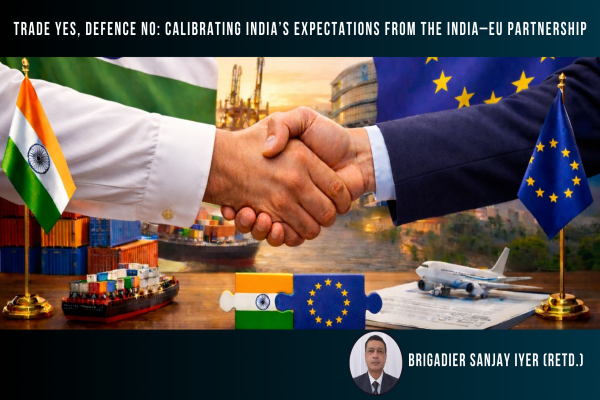
Trade Yes, Defence No: Calibrating India’s Expectations from the India–EU Partnership
January 22, 2026 Brigadier Sanjay Iyer (Retd.)
The renewed momentum around the India–EU Free Trade Agreement (FTA) deserves serious attention in New Delhi. From a commercial standpoint, the agreement is undeniably advantageous. Indian industries such as textiles, footwear, pharmaceuticals, and engineering goods stand to gain significantly from the elimination of European Union tariffs ranging between 12–16 per cent. Crucially, this provides Indian exporters competitive parity with Bangladesh and Vietnam while offering an alternative market as the United States, under the Trump administration, escalates protectionist tariffs, 25 per cent on Indian steel and 10 per cent on a broader basket of goods.
For India’s export sector, the FTA is timely insurance against growing American unpredictability. However, while trade cooperation merits optimism, expectations surrounding defence and security cooperation with the European Union must be tempered by structural realities.
Flagship EU defence initiatives, Permanent Structured Cooperation (PESCO), the European Defence Fund, or the recently announced €150 billion SAFE programme, continue to suffer from chronic coordination failures, divergent national priorities, and fragmented procurement systems. These limitations severely constrain the EU’s ability to deliver substantive defence-industrial partnerships with third countries such as India.
In practice, meaningful cooperation will continue to occur through bilateral channels with select European states willing and politically able to engage.
Other European powers face entrenched domestic constraints. Germany, for instance, remains bound by one of the world’s most restrictive export control regimes. In 2024, just 1.2 per cent of German arms exports went to Asia, with India receiving approximately €400 million, modest by any standard and subject to intense parliamentary scrutiny over end-use assurances. These restrictions are driven not by EU policy but by domestic political considerations, which will continue to limit sensitive technology transfers.
In 2024 alone, intra-EU arms trade stood at €104 billion, while NATO allies accounted for 65 per cent of EU arms imports. Within this ecosystem, India’s niche strengths in artillery or missile systems face formidable structural barriers, rendering large-scale exports improbable.
Europe’s recent defence spending surge, €326 billion in 2025, a 17 per cent increase over the previous year, further underscores this reality. As reported by the Financial Times in January 2025, EU leaders have been explicit that this spending is intended to revive domestic industry and protect European jobs. French President Emmanuel Macron’s assertion that “strategic autonomy means European industry first,” echoed by Germany’s Defence Minister Boris Pistorius rejecting even American offset arrangements, leaves little space for Indian suppliers.
These locations offer decisive advantages, faster licensing, lower labour costs (€800 per month versus €3,500 in Western Europe), and proximity to Ukraine’s immediate demand. Against this backdrop, India is commercially and strategically peripheral.
European firms operate under intense shareholder scrutiny and government oversight. Partnerships involving entities linked to Russian supply chains face delays, political opposition, or outright cancellation, regardless of India’s strategic rationale.
These actions, driven by shifting domestic politics and evolving regulatory frameworks, underline a persistent vulnerability in European supply chains, precisely when India can least afford uncertainty.
Yet the QUAD’s core strength lies in shared security stakes. Japan confronts Taiwan contingencies and Chinese assertiveness; Australia faces economic coercion and strategic encirclement; India manages land and maritime threats in its immediate neighbourhood. The EU, by contrast, approaches the Indo-Pacific largely through an economic lens.
Brussels’ reluctance to confront China is structural. EU–China trade exceeds €680 billion annually, with deep dependencies that Europe already strained by decoupling from Russia and managing US tariffs, cannot afford to jeopardise. Consequently, EU security engagement in the Indo-Pacific remains symbolic and fragmented, conducted through individual member states rather than institutional resolve.
India–EU cooperation has value, but only within defined boundaries. It complements, but cannot replace, the QUAD’s security architecture. New Delhi’s optimal strategy lies in extracting economic gains from Europe while anchoring its hard security partnerships in forums where strategic intent and capability align.
India’s strategic autonomy is best preserved by recognising Brussels for what it is, a valuable economic partner, a cautious political actor, and an unreliable security guarantor. Clear-eyed calibration not inflated expectations will ensure India maximises opportunity without strategic overreach amid China’s long shadow.
For India’s export sector, the FTA is timely insurance against growing American unpredictability. However, while trade cooperation merits optimism, expectations surrounding defence and security cooperation with the European Union must be tempered by structural realities.
The Mirage of EU Defence Integration
The recently announced India–EU Security and Defence Partnership (SDP) has generated headlines disproportionate to its likely outcomes. The EU remains fundamentally ill-suited to function as a cohesive defence actor. Its 27 member states retain sovereign armed forces, overwhelmingly oriented towards NATO rather than EU-led military structures.Flagship EU defence initiatives, Permanent Structured Cooperation (PESCO), the European Defence Fund, or the recently announced €150 billion SAFE programme, continue to suffer from chronic coordination failures, divergent national priorities, and fragmented procurement systems. These limitations severely constrain the EU’s ability to deliver substantive defence-industrial partnerships with third countries such as India.
In practice, meaningful cooperation will continue to occur through bilateral channels with select European states willing and politically able to engage.
Bilateralism Will Prevail
India’s existing defence engagements with Europe illustrate this reality clearly. Collaborations involving Indian public sector units such as HAL and BHEL, or private players like Tata and L&T, have progressed primarily through bilateral partnerships, most notably with France (Rafale fighters, Scorpène submarines) and, to a limited extent, Italy.Other European powers face entrenched domestic constraints. Germany, for instance, remains bound by one of the world’s most restrictive export control regimes. In 2024, just 1.2 per cent of German arms exports went to Asia, with India receiving approximately €400 million, modest by any standard and subject to intense parliamentary scrutiny over end-use assurances. These restrictions are driven not by EU policy but by domestic political considerations, which will continue to limit sensitive technology transfers.
Why Europe Will Not Buy Indian Defence Products
The notion that EU countries might pivot towards Indian defence exports is equally implausible. European procurement laws enforce a strict hierarchy: domestic suppliers first, followed by other EU manufacturers, NATO allies, NATO partners, and only then, if no alternatives exist, non-traditional suppliers.In 2024 alone, intra-EU arms trade stood at €104 billion, while NATO allies accounted for 65 per cent of EU arms imports. Within this ecosystem, India’s niche strengths in artillery or missile systems face formidable structural barriers, rendering large-scale exports improbable.
Europe’s recent defence spending surge, €326 billion in 2025, a 17 per cent increase over the previous year, further underscores this reality. As reported by the Financial Times in January 2025, EU leaders have been explicit that this spending is intended to revive domestic industry and protect European jobs. French President Emmanuel Macron’s assertion that “strategic autonomy means European industry first,” echoed by Germany’s Defence Minister Boris Pistorius rejecting even American offset arrangements, leaves little space for Indian suppliers.
Ukraine Has Rewired European Defence Priorities
The Ukraine war has transformed Europe’s defence-industrial landscape. Major firms such as Rheinmetall now report order books extending years into the future, Rheinmetall alone crossed €60 billion in orders in 2025. Rather than expanding production partnerships in distant markets like India, European companies are investing heavily in Eastern Europe: ammunition plants in Hungary, drone facilities in Romania, tank modernisation hubs in Poland.These locations offer decisive advantages, faster licensing, lower labour costs (€800 per month versus €3,500 in Western Europe), and proximity to Ukraine’s immediate demand. Against this backdrop, India is commercially and strategically peripheral.
Political Risk: Russia Casts a Long Shadow
India’s continued defence procurement from Russia, €4.7 billion in 2024, accounting for roughly 45 per cent of imports poses a further obstacle. In European capitals, India’s neutrality on Ukraine and its energy purchases from Moscow (approximately €47 billion since 2022) complicate trust-building for sensitive defence collaboration.European firms operate under intense shareholder scrutiny and government oversight. Partnerships involving entities linked to Russian supply chains face delays, political opposition, or outright cancellation, regardless of India’s strategic rationale.
Europe’s Reliability Problem
India’s scepticism regarding European defence reliability is grounded in experience. Over the past five decades, European states have repeatedly restricted or suspended defence supplies during India’s moments of crisis: Germany’s halt of submarine spares in 1998, Sweden’s denial of artillery ammunition during the Kargil conflict in 1999, export restrictions following India’s nuclear tests, and more recent licensing denials between 2020–2021 by Germany and Switzerland.These actions, driven by shifting domestic politics and evolving regulatory frameworks, underline a persistent vulnerability in European supply chains, precisely when India can least afford uncertainty.
Cautious Outlook: Commerce Over Co-development
The conclusion is inescapable. The India–EU FTA promises tangible economic benefits, building on a €120 billion goods trade baseline. Defence-industrial cooperation, however, should be approached with realism. While select bilateral projects will proceed, expectations of large-scale co-development or meaningful technology transfer must remain medium-term at best.Why Does the QUAD Still Matters?
This realism reinforces the enduring strategic relevance of the Quadrilateral Security Dialogue. Perceptions of a weakening QUAD stem not from internal erosion but from the United States’ attention being stretched across multiple theatres, Europe, the Middle East, and renewed hemispheric priorities under President Trump.Yet the QUAD’s core strength lies in shared security stakes. Japan confronts Taiwan contingencies and Chinese assertiveness; Australia faces economic coercion and strategic encirclement; India manages land and maritime threats in its immediate neighbourhood. The EU, by contrast, approaches the Indo-Pacific largely through an economic lens.
Brussels’ reluctance to confront China is structural. EU–China trade exceeds €680 billion annually, with deep dependencies that Europe already strained by decoupling from Russia and managing US tariffs, cannot afford to jeopardise. Consequently, EU security engagement in the Indo-Pacific remains symbolic and fragmented, conducted through individual member states rather than institutional resolve.
India–EU cooperation has value, but only within defined boundaries. It complements, but cannot replace, the QUAD’s security architecture. New Delhi’s optimal strategy lies in extracting economic gains from Europe while anchoring its hard security partnerships in forums where strategic intent and capability align.
India’s strategic autonomy is best preserved by recognising Brussels for what it is, a valuable economic partner, a cautious political actor, and an unreliable security guarantor. Clear-eyed calibration not inflated expectations will ensure India maximises opportunity without strategic overreach amid China’s long shadow.
About the Author:
Brigadier Sanjay Iyer (Retd.) is the Former Defence Attaché to Germany, Austria and Switzerland, Government of India
Note:
The Op-Ed reflects the opinion of the author and not necessarily the views of the organisation.
Share this article:
© Copyright 2026 Indic Researchers Forum | Designed & Developed By Bigpage.in