
What to Expect from the Delhi BRICS Summit?
September 12, 2026 Rajat Ganguly
Any major international event, such as a summit meeting, sends two very distinct types of messages or signals to the world at large. The first message concerns the 'optics of the summit'. From the visuals and the speeches that we get to see and hear, we can deduce a certain meaning or signal that the summit is conveying to the world. The second message concerns the substantive discussions and the tangible outcomes from the summit, which may (or may not) provide a road map for future actions and progress.
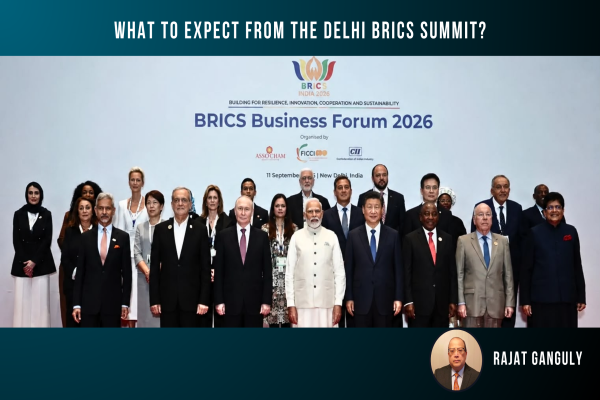
From what I have seen and heard from yesterday at the Delhi BRICS summit, here are my main takeaways regarding the first messaging.
First, yesterday's visuals confirm India's leading role as a key leader of the Global South. Indian Prime Minister Modi's words and the overall tone of the summit suggest that BRICS will be the main voice of the Global South, and India will play a lead role in setting the Global South's agenda and narrative.
Second, it is fashionable these days to talk about an emerging multi-polarity and the redistribution of power within the international system. With the rise of Great Powers like Russia, China, India and others such as Iran, a multi-polar redistribution of power is certainly taking shape, which will eventually bring to an end the post-Cold War era of American exceptionalism and global hegemonic dominance. While this is inevitable, what is also taking shape, at least in my view, is a binary division of the world into a Global South versus a Global North. The 'language' used by these two blocs are markedly different. While the Global North (America and Europe combined) keeps using terms like 'dominance', 'hegemony', 'control', 'war', 'weapons', etc., the Global South's terminology emphasizes 'development', 'trade', 'shared prosperity', 'peace', 'diplomacy', and so on. In other words, in tone and style, the political priority and interest of the Global North and Global South are fundamentally different. This is clearly evident so far at the Delhi BRICS summit.
Third, Modi walking hand-in-hand with Iranian President Masoud Pezeshkian was for me a powerful signal that the Global South stands firmly with Iran at a time when the country is at war with the United States and Israel. Modi's separate bilateral with Pezeshkian also signaled the seriousness with which India wants to engage with Iran, a country under severe American economic sanctions. Was Modi signaling India's defiance of US sanctions by engaging so cordially with Pezeshkian? Will India follow this up by buying Iranian oil in defiance of US sanctions? These ought to be the questions Trump administration people are asking in Washington, D.C.
Fourth, President Putin's arrival one day before the summit is to officially convene indicates for me something very big may be around the corner in Indo-Russian ties. This could involve major defence deals, commercial agreements, and concrete steps to expand Indo-Russian trade to over $100 billion by 2030. Modi's body language with Putin (such as the warm hug) during the bilateral with Russia could be India's way of signaling to the United States and the West that Delhi will not bow to pressure not to engage economically and strategically with Russia.
Finally, some critics of India have argued that India is a stumbling bloc within BRICS in the sense that India does not want BRICS to become an anti-US and anti-West organization dominated by China and Russia. Some other critics have suggested that it would be wise for India to ditch BRICS and align more closely with the United States and the West. Modi's style and rhetoric at the Delhi BRICS summit so far has clearly answered these critics in my opinion. He has talked about BRICS being a 'family' that represents over half the global population and 40% of global GDP. India as the fastest growing major economy is an important member of that family. But Modi has been careful to suggest that BRICS is not directed at anybody or any bloc, a sentiment echoed by President Putin.
The next two days (today and tomorrow) may bring several challenges to the fore and it will be interesting to see how Modi and Indian diplomacy handles these challenges. Everybody's eyes will be glued to the arrival of President Xi Jinping and his interactions with Modi and the other leaders. The crucial question will be whether India and China can manage to tone down and control their differences on key issues (such as the border dispute) and focus on delivering win-win outcomes for India, China and BRICS. Another contentious issue will be de-dollarization and the promotion of intra-BRICS trading in local currencies. According to the Iranian Foreign Minister Abbas Araghchi, the discussions on a common BRICS currency are at a very elimentary stage. So, I do not expect any major announcements in that regard. But some progress can be expected with regards to boosting intra-BRICS trade, investment, and the use of local currencies. An additional challenge for Modi and Indian diplomats will be to manage the tense relations between Iran and other BRICS members such as the UAE. In other words, the fallout from the Iran war may emerge as a very sensitive issue in BRICS deliberations and may even prevent a joint statement from being issued at the end of the summit. If substantive progress is not made on core issues such as trade, investment, and local currency use to settle trade, and if a joint statement remains out of reach, it may indicate a failure of the summit with regards to the second messaging. If that were to happen, it may strengthen the argument of Western critics that there are too many contradictions within BRICS for it to be an effective voice of the Global South and a serious counter to the West. The picture should be clearer by Sunday evening.
From what I have seen and heard from yesterday at the Delhi BRICS summit, here are my main takeaways regarding the first messaging.
First, yesterday's visuals confirm India's leading role as a key leader of the Global South. Indian Prime Minister Modi's words and the overall tone of the summit suggest that BRICS will be the main voice of the Global South, and India will play a lead role in setting the Global South's agenda and narrative.
Second, it is fashionable these days to talk about an emerging multi-polarity and the redistribution of power within the international system. With the rise of Great Powers like Russia, China, India and others such as Iran, a multi-polar redistribution of power is certainly taking shape, which will eventually bring to an end the post-Cold War era of American exceptionalism and global hegemonic dominance. While this is inevitable, what is also taking shape, at least in my view, is a binary division of the world into a Global South versus a Global North. The 'language' used by these two blocs are markedly different. While the Global North (America and Europe combined) keeps using terms like 'dominance', 'hegemony', 'control', 'war', 'weapons', etc., the Global South's terminology emphasizes 'development', 'trade', 'shared prosperity', 'peace', 'diplomacy', and so on. In other words, in tone and style, the political priority and interest of the Global North and Global South are fundamentally different. This is clearly evident so far at the Delhi BRICS summit.
Third, Modi walking hand-in-hand with Iranian President Masoud Pezeshkian was for me a powerful signal that the Global South stands firmly with Iran at a time when the country is at war with the United States and Israel. Modi's separate bilateral with Pezeshkian also signaled the seriousness with which India wants to engage with Iran, a country under severe American economic sanctions. Was Modi signaling India's defiance of US sanctions by engaging so cordially with Pezeshkian? Will India follow this up by buying Iranian oil in defiance of US sanctions? These ought to be the questions Trump administration people are asking in Washington, D.C.
Fourth, President Putin's arrival one day before the summit is to officially convene indicates for me something very big may be around the corner in Indo-Russian ties. This could involve major defence deals, commercial agreements, and concrete steps to expand Indo-Russian trade to over $100 billion by 2030. Modi's body language with Putin (such as the warm hug) during the bilateral with Russia could be India's way of signaling to the United States and the West that Delhi will not bow to pressure not to engage economically and strategically with Russia.
Finally, some critics of India have argued that India is a stumbling bloc within BRICS in the sense that India does not want BRICS to become an anti-US and anti-West organization dominated by China and Russia. Some other critics have suggested that it would be wise for India to ditch BRICS and align more closely with the United States and the West. Modi's style and rhetoric at the Delhi BRICS summit so far has clearly answered these critics in my opinion. He has talked about BRICS being a 'family' that represents over half the global population and 40% of global GDP. India as the fastest growing major economy is an important member of that family. But Modi has been careful to suggest that BRICS is not directed at anybody or any bloc, a sentiment echoed by President Putin.
The next two days (today and tomorrow) may bring several challenges to the fore and it will be interesting to see how Modi and Indian diplomacy handles these challenges. Everybody's eyes will be glued to the arrival of President Xi Jinping and his interactions with Modi and the other leaders. The crucial question will be whether India and China can manage to tone down and control their differences on key issues (such as the border dispute) and focus on delivering win-win outcomes for India, China and BRICS. Another contentious issue will be de-dollarization and the promotion of intra-BRICS trading in local currencies. According to the Iranian Foreign Minister Abbas Araghchi, the discussions on a common BRICS currency are at a very elimentary stage. So, I do not expect any major announcements in that regard. But some progress can be expected with regards to boosting intra-BRICS trade, investment, and the use of local currencies. An additional challenge for Modi and Indian diplomats will be to manage the tense relations between Iran and other BRICS members such as the UAE. In other words, the fallout from the Iran war may emerge as a very sensitive issue in BRICS deliberations and may even prevent a joint statement from being issued at the end of the summit. If substantive progress is not made on core issues such as trade, investment, and local currency use to settle trade, and if a joint statement remains out of reach, it may indicate a failure of the summit with regards to the second messaging. If that were to happen, it may strengthen the argument of Western critics that there are too many contradictions within BRICS for it to be an effective voice of the Global South and a serious counter to the West. The picture should be clearer by Sunday evening.
About the Author:
Rajat Ganguly is the Editor-in Chief of Journal of Asian Security and International Affairs and Journal of World Affairs: Voice of the Global South.
Note:
The article reflects the opinion of the author and not necessarily the views of the organisation.
Share this article:
© Copyright 2026 Indic Researchers Forum | Designed & Developed By Bigpage.in